Showing posts with label jinn. Show all posts

Without the Window, It's Not Worthwhile


Without the window it’s not worthwhile. To think of the exorbitant rates of plane tickets, how soon the journey is over, clearly the most valuable item up for grabs is the view. Consequently, it is entirely unsatisfactory to slum it in the aisle or worse, squashed between unwelcome strangers in the middle seat, especially when the price is the same. Those other seats are simply a rip off for people who know no better, who cannot have enjoyed a window seat previously. Without a window seat it’s not worth flying. It’s perfectly reasonable not to board the plane.

These are not my words. While I tend to prefer the window I would not refuse to fly; nor would I expend so many words explaining my preference. For Iqbal, silence was a negative waiting to be filled. His tips and stories came like a flash flood, bowled you over with barely time to recover before the next flood began.


Farsi is a language of exquisite beauty. It’s the language of great literature, of poets like Hafez and Saadi and simply to hear the language spoken is like a melody from heaven. The phrases used even for everyday speech are poetic and enlightening. Of course Iqbal couldn’t appreciate the entirety of it, but from his Urdu he could glean enough. He was Pakistani and it was a dreadful loss for my Australian friend Lachlan and me to be in Iran surrounded by the sweetest language unable to comprehend a single word.

Farsi is beautiful. I would say we might have told Iqbal we had Farsi lessons and were more than beginners, but it’s not easy to spit into a raging torrent. And yet, Iqbal was very likeable.

We were on the same flight from Bandar Abbas to Chah Bahar in eastern Iran, in Iran’s Baluchestan. Flights were very cheap in Iran with one way fares as low as ten dollars due to the appalling, for the Iranians, exchange rate. I don’t think we met on the plane, as Iqbal found the window seat in front of mine – but as we needed transport from the airport into Chah Bahar town, we shared a taxi.


It’s unacceptable to use somebody else’s bathroom. If one needs to use the bathroom they should certainly do it before leaving home, before arriving at another person’s home as a valued guest. Children should be instructed same. There is nothing worse than visiting another man’s bathroom – it will leave the host wondering if it was them you came to see or if you only came to use the plumbing.

No comment from me.

Chah Bahar has its Baluchi ways that were significantly different to most of Iran. Baluchis were mostly Sunni and their clothes harked more to the subcontinent than to the country’s west. The only difficulty, common to all port cities in Iran, hotels for foreigners were expensive. As Iqbal really was a nice guy, the three of us agreed to share a room, with two single beds and a mat on the floor for me, in between.

It was in that small period between the turning off the light and the sleep arriving, with the very last of the day’s chat winding down, when I heard one of the strangest sentences ever. We were finally asking Iqbal why he was in Iran. Through the darkness I heard him say, “I lost my jeans. I’ve come to find them.”

Politeness says a small reply is in order, something along the lines of “oh, that’s nice” or “I hope you find them.” I don’t recall if I managed to squeeze something out, but I was entirely grateful for the darkness – nobody could see me biting hard on my lip to prevent laughter from bursting out. It was helpful that I couldn’t see Lachlan’s face at that stage, because I knew he would be having great difficulty holding his own laughter back. But the silence – it was no longer a negative waiting to be filled – it was substantial, unbearably heavy and with the force of a category five cyclone. That silence couldn’t be resisted.

I heard the first busts from Lachlan’s closed mouth – and then we roared laughing, both of us – unseemly, rude and for several minutes, unstoppable. Iqbal didn’t understand what was humorous.

There were some obvious questions – why would a man lose a pair of jeans in a neighbouring country – had he been there before or were they somehow smuggled over the border? How regularly is it that people travel abroad in search of missing trousers?

When the laughter eased and we sought explanation it became apparent we’d misunderstood. It wasn’t his jeans he’d lost but his jinns. He’d sent them to Iran and they’d not returned. Of course, the concept of losing one’s jinns also raises some obvious questions – but it was better not to ask. It was time to sleep.

We took the plane on to Zahedan, the capital of Iran’s Sistan and Baluchestan province and not very far from the border with Afghanistan. Iqbal was with us – he was going the same way – and he was still a rather good and likeable guy. So we stayed at the same hotel.


If you ever happen to get shot in the leg, it’s certainly no excuse for interrupting a dinner party. Particularly if it’s a family birthday party and others are in high spirits in the hope of an entertaining night over a meal, then it’s better not to mention the shooting. As for the blood that’s dripping on the floor under the table, a fistful of napkins can help, and if it’s done discretely nobody need know. Then, once the meal is completed, it will possible to drive the wife and children home before quietly continuing on to check into a hospital.

It was the first moments in Zahedan that I started to consider that Iqbal might indeed have some kind of superpower. Lachlan and I had gone to buy water and I was discussing Iqbal’s flourishing communicativeness. I said, “He can talk on any topic. He could talk for an hour about his socks!” Socks was random; yet minutes later, back at the hotel when we went to find Iqbal to go sightseeing, he was just putting on his socks.
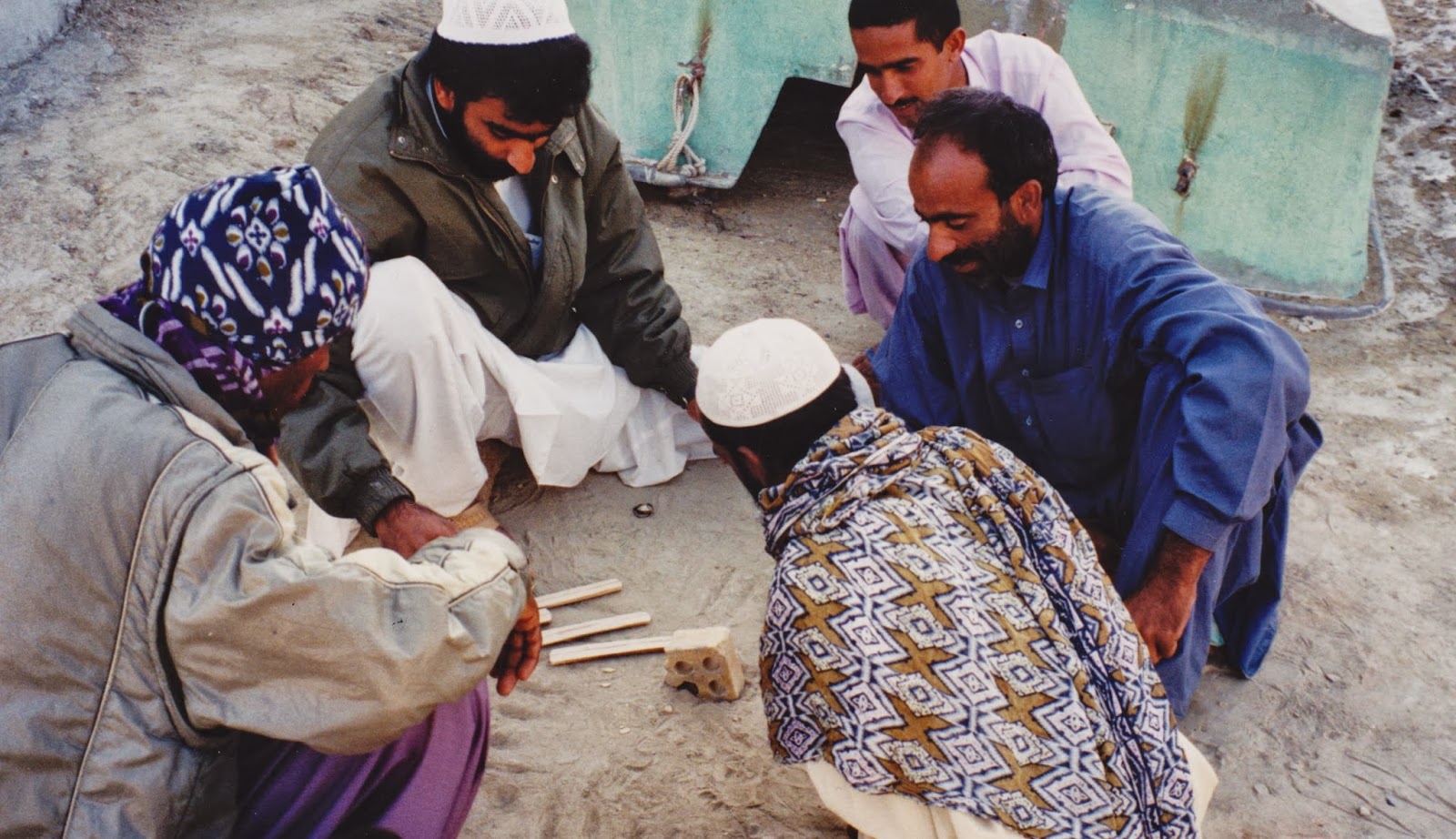


The best socks are made with thicker wool by Afghans. You can buy them at the Afghan market and other socks simply won’t compete – Afghan socks are warmer and more comfortable and never get holes in them because they are hand knitted. Once you’ve worn Afghan socks you’ll never wear others. If it’s not Afghan the socks aren’t worth buying.

Zahedan is picturesque with its backdrop of jet black hills. We took to the city’s photogenic suburbs with their mud brick houses. It was inevitable that in the mix of buildings we’d end up standing on somebody’s roof. What was unexpected was that the householder came rushing out and asked us not to stand there because it might collapse. Instead, he invited us to come in for tea.

We chatted with the Zahedani and he was rather impressed by our Farsi. For some reason, maybe his accent, we could understand him well while Iqbal struggled. “These two have come from the other side of the world,” said the Zahedani, “and their Farsi is good, but you come from a neighbouring country and you can’t understand.”


Yet he really was nice guy, Iqbal. So what did it matter if he’d lost his jinns? It could happen to anybody.


The story of apparel cannot be told by jeans and socks alone... There'd need to be...


                        various knitwear items in vomit green...


                                                                                         a sari shawl in alpaca, of course!

                                     the very latest in elegant, chic, forest wear...


This article also published in Star Magazine, here: Without the Window, It's Not Worthwhile

Diabula Did It


It must’ve taken a measure of bravery for the Portuguese to first set out on their voyages of discovery in the fifteenth century.  With the weight of the unknown, the myths of sea monsters and risk of falling off the edge of a flat world they nonetheless set forth.  By the following century they’d made it as far as the Bay of Bengal where ultimately they established a port in Chittagong and a settlement on nearby Sandwip Island.  But did they ever get lost along the way?  From time to time they must have.  And when they got lost, could it be that the Portuguese turned their sails around while at the same time cursing the very devil for having deceived them?

Kashem Bhai of Rahania village in modern-day Hatiya is not Portuguese and he certainly has little in common with Henry the Navigator or Vasco Da Gama.  Unlike any Portuguese explorer indeed, it is with considerable care that Kashem Bhai contemplates his actions, and the actions of others.  He’s someone who finds no delight in risk-taking. 

In the night sky over Hatiya, every few minutes there are the lights of planes, transcontinental, small and very high.  We’ve considered it might be the Hong Kong to Dubai route.  While watching the planes, Kashem Bhai has been known to remark, ‘How risky!  Do people really need to do that?  Why do they take such risks?’  He’s rehearsed a rather nice sound of a plane falling from the sky: durrrumm!  It’s safe to assume he belongs to my grandmother’s school of thought, that if people were meant to fly they’d have grown wings.  And it’s not the only risky behaviour Kashem Bhai has noticed among his fellow humans.

There’s also the important matter of ceiling fans.  Kashem Bhai wonders how it is that people can sleep under them, what should happen if during the night the fan were to fall.  ‘How risky!’ he says, ‘Why do people trust their lives to a single, small screw!’ He means the one holding the fan in place.  ‘Is it really necessary?’  Living in Rahania, Kashem Bhai is lucky not to have to face the threat of ceiling fans often.  On any island electricity is not a straightforward matter and what electricity there is in Hatiya seems to have got lost somewhere along the way to Kashem’s village.

It comes as a surprise, therefore, to hear of the occasion when Kashem Bhai’s careful planning and risk avoidance considerations failed him.  It was on a day that started like any other.  As with many a villager, Kashem’s hours are normally consumed with chores and duties, household this and marketing that.  But on that day Kashem Bhai decided he was in need of rest, and as he lives by the Hatiyan coastline it was little trouble to gather a few friends and propose several hours of adda at the beach.  There’s usually a welcome breeze blowing in from the Bay of Bengal there, he knew, and it’s not a place where the day’s duties could track him down.

Getting there presents few problems.  It’s simple enough to follow path-and-aisle between the rice fields and to negotiate the muddy crossings of the tidal channels in the open land they call ‘The Garden.’ Nor is it overly challenging to zigzag through gaps in the coastal shawl of the mangroves beyond.  There’s usually a patch of dry sand or a grassy clearing nearby; the local fishermen can advise as to the best place for adda on any day, in accordance with the Bay of Bengal’s latest artistry. 

But it’s also a simple scientific fact that adda is not restricted by daylight or tides, and it was well into the afternoon the small party of conversationalists thought to return.  The best way back changes as tides come in and in the darkness it’s not as simple to watch out for cobras; nor are there too many paths to choose from due to the channels and the rice fields.  But as that afternoon wore on there arose an even more pressing problem: society and that peculiar disadvantage of being a respectable member of it.

Unfortunately, on the very day Kashem Bhai determined to go to the beach was also scheduled an important shalish, a public mediation.  Even from the beach Kashem could see the distant bazaar was crowded with onlookers and participants, ready for the event.  Kashem Bhai considered his reputation: what would people think if they saw his little group of friends returning from the beach at a late hour?  Would word of their wasting time on adda reach their wives?  So they waited.

Unfortunately the mediation was a land dispute that had generated a good deal of interest.  There was much to be said and technicalities to be considered.  It’s a simple scientific fact that village mediations are not restricted by daylight or tides.  As the path to the bazaar started fading towards darkness and the water started coming in, it seemed as though the shalish would never end. 

Eventually the group could wait no longer; but if perhaps they walked apart they might yet be able to reach their homes inconspicuously.  At any rate they’d need to try.  One by one they set off: through the mangroves, jumping over muddy channels and weaving a way through The Garden.

The crowd proved to be a blessing, with each of Kashem’s friends able to enter the market from the sea side unhindered and without remark.  It was dark by then.  But unfortunately, just as Kashem Bhai’s feet found the start of the bazaar he was spotted.  ‘Kashem Miah, where have you been?’ Abdullah Member asked.

Kashem Bhai didn’t know what to say.  But fortune favoured him because after a moment a convenient skerrick of local folklore came to mind: the legendary Diabula.

Kashem embarked upon a carefully crafted tale, about how he had been walking home from the bazaar to his house as he usually might, when for some reason he found himself walking and walking, still walking, and still not seeming to cover the short distance to his home.  Finding his situation odd, Kashem Bhai explained, he started to think it was Diabula’s work. 

In Hatiya, Diabula is an invisible spirit but not a jinn or a bhoot of the ordinary sort.  Diabula has the particular trick of snatching people’s sense of direction and leading them astray; and people are at greatest risk of attack when they walk alone.

Kashem Bhai told Abdullah Member that he stopped walking and on suspicions of Diabula thought to turn his lungee upside down.  This action is the commonly understood remedy for Diabula’s handiwork.  And when he did so, just about half an hour earlier, Kashem Bhai continued, he was shocked to find himself, quite inexplicably, at the beach!

Having enjoyed the little tale, Abdullah Member could have no further questions.

It’s strange to think that the Portuguese journeys of several hundred years ago may have assisted Kashem Bhai as he entered the bazaar that day.  It’s just a theory, but is it impossible to imagine that the islanders’ Diabula was long ago derived from the Portuguese diabo, the word for the devil? 

Hatiya Island didn’t exist when the Portuguese came to the Bay of Bengal, it’s a much younger island; but many Hatiyalas have an ancestry from the older Sandwip, far to the east.  And when I mentioned Diabula to a Sandwipian friend he knew what it was immediately; he also knew to turn his lungee upside down in the case of a Diabula attack.  Meanwhile those few people I asked from inland districts of Bangladesh had never heard of Diabula.


Free counter and web stats