Showing posts with label travel. Show all posts
Showing posts with label travel. Show all posts

Without the Window, It's Not Worthwhile

Without the window it’s not worthwhile. To think of the
exorbitant rates of plane tickets, how soon the journey is over, clearly the
most valuable item up for grabs is the view. Consequently, it is entirely
unsatisfactory to slum it in the aisle or worse, squashed between unwelcome
strangers in the middle seat, especially when the price is the same. Those
other seats are simply a rip off for people who know no better, who cannot have
enjoyed a window seat previously. Without a window seat it’s not worth flying.
It’s perfectly reasonable not to board the plane.
These are not my words. While I tend to prefer the window I
would not refuse to fly; nor would I expend so many words explaining my
preference. For Iqbal, silence was a negative waiting to be filled. His tips
and stories came like a flash flood, bowled you over with barely time to
recover before the next flood began.

Farsi is a language of exquisite beauty. It’s the language
of great literature, of poets like Hafez and Saadi and simply to hear the
language spoken is like a melody from heaven. The phrases used even for
everyday speech are poetic and enlightening. Of course Iqbal couldn’t
appreciate the entirety of it, but from his Urdu he could glean enough. He was
Pakistani and it was a dreadful loss for my Australian friend Lachlan and me to
be in Iran
surrounded by the sweetest language unable to comprehend a single word.
Farsi is beautiful. I would say we might have told Iqbal we
had Farsi lessons and were more than beginners, but it’s not easy to spit into
a raging torrent. And yet, Iqbal was very likeable.
We were on the same flight from Bandar Abbas to Chah Bahar
in eastern Iran , in Iran ’s
Baluchestan. Flights were very cheap in Iran with one way fares as low as
ten dollars due to the appalling, for the Iranians, exchange rate. I don’t
think we met on the plane, as Iqbal found the window seat in front of mine –
but as we needed transport from the airport into Chah Bahar town, we shared a
taxi.

It’s unacceptable to use somebody else’s bathroom. If one
needs to use the bathroom they should certainly do it before leaving home,
before arriving at another person’s home as a valued guest. Children should be
instructed same. There is nothing worse than visiting another man’s bathroom –
it will leave the host wondering if it was them you came to see or if you only
came to use the plumbing.
No comment from me.
Chah Bahar has its Baluchi ways that were significantly
different to most of Iran .
Baluchis were mostly Sunni and their clothes harked more to the subcontinent
than to the country’s west. The only difficulty, common to all port cities in Iran , hotels
for foreigners were expensive. As Iqbal really was a nice guy, the three of us
agreed to share a room, with two single beds and a mat on the floor for me, in
between.
It was in that small period between the turning off the
light and the sleep arriving, with the very last of the day’s chat winding
down, when I heard one of the strangest sentences ever. We were finally asking
Iqbal why he was in Iran .
Through the darkness I heard him say, “I lost my jeans. I’ve come to find
them.”
Politeness says a small reply is in order, something along
the lines of “oh, that’s nice” or “I hope you find them.” I don’t recall if I
managed to squeeze something out, but I was entirely grateful for the darkness
– nobody could see me biting hard on my lip to prevent laughter from bursting
out. It was helpful that I couldn’t see Lachlan ’s
face at that stage, because I knew he would be having great difficulty holding
his own laughter back. But the silence – it was no longer a negative waiting to
be filled – it was substantial, unbearably heavy and with the force of a category
five cyclone. That silence couldn’t be resisted.
I heard the first busts from Lachlan ’s
closed mouth – and then we roared laughing, both of us – unseemly, rude and for
several minutes, unstoppable. Iqbal didn’t understand what was humorous.
There were some obvious questions – why would a man lose a pair
of jeans in a neighbouring country – had he been there before or were they
somehow smuggled over the border? How regularly is it that people travel abroad
in search of missing trousers?
When the laughter eased and we sought explanation it became
apparent we’d misunderstood. It wasn’t his jeans he’d lost but his jinns. He’d
sent them to Iran
and they’d not returned. Of course, the concept of losing one’s jinns also
raises some obvious questions – but it was better not to ask. It was time to
sleep.
We took the plane on to Zahedan, the capital of Iran ’s Sistan and Baluchestan province and not
very far from the border with Afghanistan .
Iqbal was with us – he was going the same way – and he was still a rather good
and likeable guy. So we stayed at the same hotel.

If you ever happen to get shot in the leg, it’s certainly no
excuse for interrupting a dinner party. Particularly if it’s a family birthday
party and others are in high spirits in the hope of an entertaining night over
a meal, then it’s better not to mention the shooting. As for the blood that’s
dripping on the floor under the table, a fistful of napkins can help, and if
it’s done discretely nobody need know. Then, once the meal is completed, it
will possible to drive the wife and children home before quietly continuing on
to check into a hospital.
It was the first moments in Zahedan that I started to
consider that Iqbal might indeed have some kind of superpower. Lachlan and I had gone to buy water and I was discussing
Iqbal’s flourishing communicativeness. I said, “He can talk on any topic. He
could talk for an hour about his socks!” Socks was random; yet minutes later,
back at the hotel when we went to find Iqbal to go sightseeing, he was just
putting on his socks.
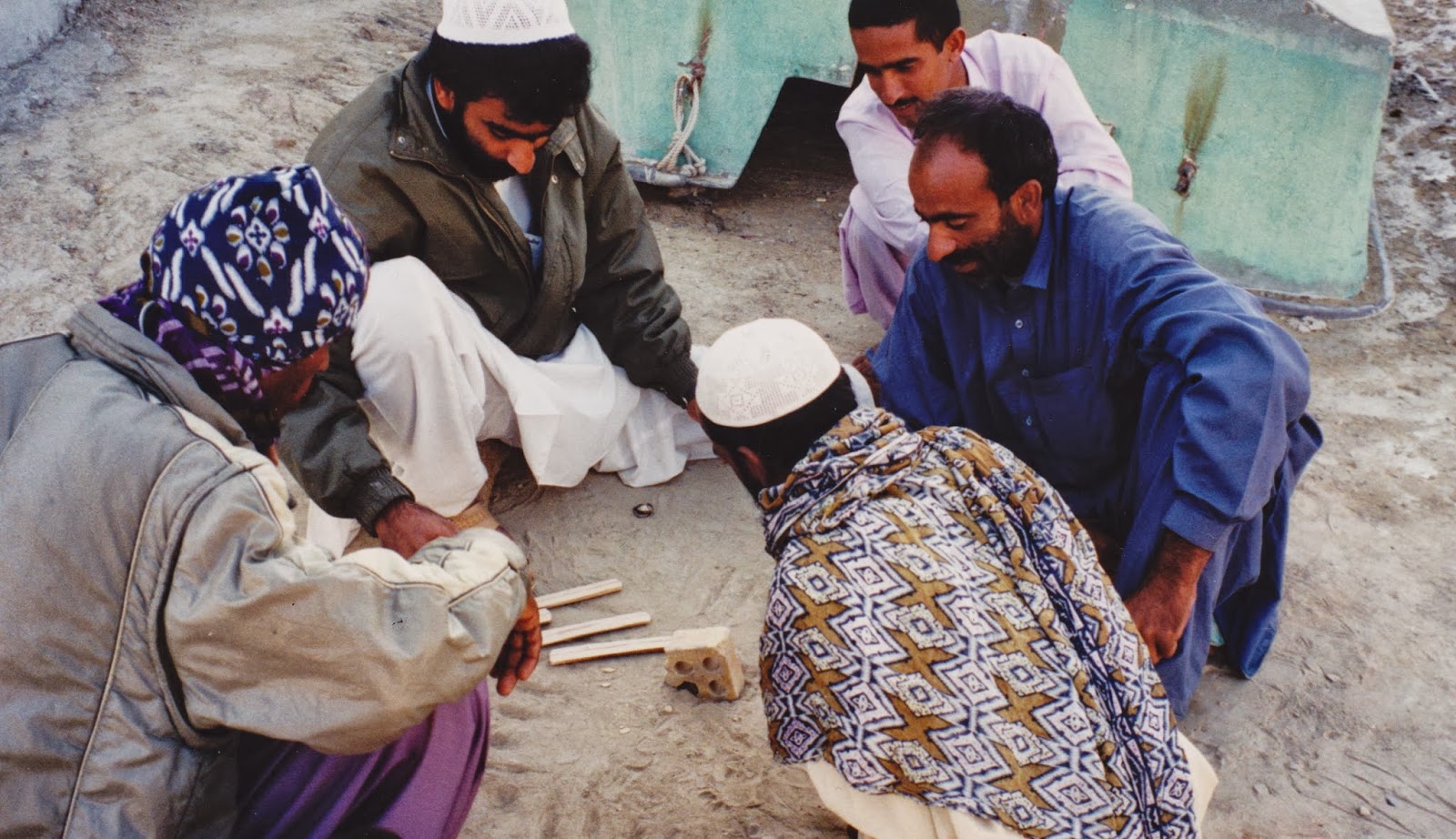
The best socks are made with thicker wool by Afghans. You
can buy them at the Afghan market and other socks simply won’t compete – Afghan
socks are warmer and more comfortable and never get holes in them because they
are hand knitted. Once you’ve worn Afghan socks you’ll never wear others. If
it’s not Afghan the socks aren’t worth buying.
Zahedan is picturesque with its backdrop of jet black hills.
We took to the city’s photogenic suburbs with their mud brick houses. It was
inevitable that in the mix of buildings we’d end up standing on somebody’s
roof. What was unexpected was that the householder came rushing out and asked
us not to stand there because it might collapse. Instead, he invited us to come
in for tea.
We chatted with the Zahedani and he was rather impressed by
our Farsi. For some reason, maybe his accent, we could understand him well
while Iqbal struggled. “These two have come from the other side of the world,”
said the Zahedani, “and their Farsi is good, but you come from a neighbouring
country and you can’t understand.”
Yet he really was nice guy, Iqbal. So what did it matter if
he’d lost his jinns? It could happen to anybody.

The story of apparel cannot be told by jeans and socks alone... There'd need to be...
Was There Any Chance of Wolves?

Anonymity is a blessing in the short term. It’s true that it
means you’re far from family and friends, but it also means never having to be
anywhere at a particular time and doing exactly what you wish without
consultation; it’s a bit like growing up and no longer being answerable to
parents. Anonymity is a key component to the traveller’s freedom, the treasure
of the road.
It was the first trip to Latvia , one week, and the day arrived
for that fateful tour to Bauska. I’d taken up residence with newly met locals
Dzintra and her daughters, Antra and Anta. Bauska was the plan for while they
were busy with school, university and work.
The largely flat Latvian countryside has something in common
with Bangladesh : there are a
good number of palaces from the lord-and-peasant past, what in Bangladesh
would be called a rajbari. Near
Bauska is one such place, Rundales Pils, a baroque palace built for the Dukes
of Courland from 1736. It was the goal.
Indeed the journey was completed easily and the palace was
impressive. It was on the way home again to Riga when things went wrong.
With the blessing of anonymity there was nobody to ask
whether it was a good idea to take a little walk in the countryside in the
belief it would not be difficult to find a different way back to Bauska town
for the bus. Besides, there was a footbridge over a small river made of oil
drums tied together, floating and with planks on top, which really needed to be
crossed.
Entirely without care I found myself of a picturesque
stretch of dirt road, entirely straight, walking merrily. But it was a strange
phenomenon for the road seemed to lengthen with each step. An hour passed, then
two, and all the while there were open fields without a single house in sight.
Could such a scene exist in a country as small as Latvia ? More disturbingly, not a
single car had passed by.
 |
| There are Latvian rivers with fishermen. I just didn't find any. |
There comes that point when you wonder if turning back
wouldn’t be more sensible, but the oil drum bridge already seemed distant and
surely it wasn’t really possible to be lost in Latvia .
The road continued and so did I.
The road continued and so did I.
Early evening arrived and with the sun my confidence in
direction gradually set. That point comes: ‘what’s the worst that could
happen?’ I started to contemplate sleeping in a field and waiting for morning.
Was it dangerous to sleep in a Latvian field? It’s true the country was called
the wild east back then, but surely that meant human society, in the cities.
Was there any chance of wolves?
Okay: worst scenario, Latvian field, one night. I kept
walking.
At about the stage where my legs felt they might refuse to
go on, something exciting happened. I came to a road junction. There was no
house or car, and only more fields, but for the first time in several hours I
had a choice: left, right or straight ahead? On my first day in Latvia I’d made
a choice for the left; this time I chose right. And I walked.
 |
| There are houses in Latvian villages. I just didn't see any. |
A few minutes later something more exciting happened. It was a sound: the oil and metal rumble of a car. Sure enough, it came along kicking up dust: a kind of red sports car. Normally it’d be courteous to stand to the side and politely flag down the vehicle, with acknowledgement it was a favour if they stopped. But the situation was not normal.
I stood road centre, hands out in a kind of ‘halt’, like a
dacoit or a police officer. The car had no choice.
Inside was a couple. It was strange because when he decided
to stop rather than run me down, she was rather angry about it. I’m not sure
which language it was they spoke, but it sounded like Russian and there was
clearly some kind of domestic dispute going on. ‘What are you stopping for you
idiot!’ I imagined her yelling. She really was screaming at him.
‘What do you expect me to do, leave him here?’ I imagined
him replying, marginally more calmly.
‘You never spend enough time with me! You are always with
your wife!’ Or perhaps she was the wife. Whatever the specifics I was sure of
one thing: I was getting in that car, whether the lady liked it or not. It’s
not that I’m in the habit of interfering in other people’s domestic upheavals.
It’s just that, at a minimum they could take me to a main road, wherever that
might be, hopefully still in Latvia . I could only say ‘Riga ’.
Laugh if you will but after all that walking and after all
her screaming the main road was but a few hundred yards further. It was a very short ride indeed. She was pleased I got out; the guy was nice
about it. ‘Paldies,’ I said, Dzintra-taught, ‘Thanks.’
It was dark when I stood on the side of the highway. There were cars but nobody was stopping; who
could blame them? So I walked a bit, and
I’d been sure to get the sports car driver to indicate the Riga-direction of
the road when he’d dropped me off. After
some time there was a bus shelter and I thought, ‘Would it be safe to stay one
night in a Latvian bus shelter?’ It seemed unlikely anybody would stop before
morning. Personally I would’ve favoured
the field with whatever risk of wolves there was.
Well fortunately there’s this little thing called public
transport, and fortunately the international express services between Riga and Lithuania
used that route. They don’t officially
stop except in major towns, except that, fortunately and like in Bangladesh ,
they do. They will pick up the odd stray like me for a small fee. A bus stopped
and I was saved. I was so relieved that
I’d be making it back to the city that from my pocket I pulled out a few coins
at random and proudly presented them to the driver.
 |
| This would have been a better road to get lost on, on account of the passerby and the house. |
The bus driver was a good fellow, for I hadn’t even counted
what I’d dumped into his hand, so grateful I was at having been saved. There’d
been a few too many tiny brown coins involved; he gave some back.
 |
| If the moss grows on the north side, Lithuania is to the south. |
It was funny, that first week in Latvia . It was odd to be far from
home, where I should have enjoyed the full benefit of anonymity, to have had
that plaguing thought the whole time: Dzintra would be worried. By the time I reached the apartment it was approaching
midnight. I rang the bell.
Well, the door swung open and there was an enormous hug. ‘I
was so worried about you!’ she said, ‘If something happened… I don’t even know
your surname! What would I tell your family and how would I find them?’ After
that, I wrote my full name and address on a piece of paper. Needed. Multiple Lives. Latvia gets one.

Post Latvian apartment, you can take accommodation in a construction site, an Arctic cupboard or alternatively, set up your own guest house...
For the start of the Latvian story, you'll need to visit The Latvian National Academy of Science
Or follow the Baltic Way, along the sea on a trail of amber...
This article is also published in Star Magazine, here: Was There Any Chance of Wolves?
Potato and Toothpaste Travel

Amber is fossilised tree resin, a yellowish, pellucid gem washed ashore by the waves of the eastern
I’d nearly not stayed there but fate granted a second
chance. As I’d walked away north on that day I’d randomly met Dzintra at the doors
of the Science Academy

Yet there was a sliver of hope: I was due to meet her
daughter Antra on the following morning. Dzintra had said there was a castle
not too far from Riga ,
that it was worth seeing and I could take the train there. Without any
alternative plan it certainly sounded like a plan. She had to work, she said,
but if her daughter was not busy with university she could meet me at the
entrance to Riga
station at 9 a.m. because her daughter would enjoy the trip too. Maybe.
‘How will she recognise me?’ I asked. It wasn’t as if I
stood out in the Latvian crowd.
‘She can find you,’ Dzintra assured.
It wasn’t a meeting arrangement to inspire any confidence
but there was only to wait and see. What did my intuition say? Unfortunately,
it said nothing.
Anyway, there was a more immediate and pressing concern: would
I really find the private apartment I’d left that morning, without really
taking in properly where it was?
Eventually I did happen to happen upon the right street.
At 9 a.m. on the following day, at the busy Riga station, I thought it quite impossible
anybody could find me in the crowd. But sure enough, as I stood waiting, a
young woman approached, saying cautiously, ‘Excuse me, you are Andrew?’ It was
Antra.
‘How did you recognise me?’ I asked, quite shocked.
‘You look like a foreigner,’ she said, ‘a bit lost.’
The day at the castle was like a meandering flute melody, made
easier by Antra’s English skills. The offer to stay was repeated by the
daughter. This time I accepted. I fetched my luggage from somewhere North Riga and returned the house keys to the apartment’s
owner. By evening I’d been whisked over the Daugava River
Events in the Stalin-era apartment were amusing. There was
quite a bit of fussing that went on, unexpectedly, over Dzintra’s dinner.
‘Did you eat?’ I heard her school-going younger daughter
Anta, ask.
‘I had my dinner,’ Dzintra replied.
‘What did you eat?’ the daughter pressed.
‘Oh, you know…’ the mother said.
‘What about your dinner?’ her older daughter Antra also asked,
upon coming home again later.
‘Yes, I ate.’
‘It wasn’t only potatoes, was it?’
‘No,’ Dzintra said, calling me as a witness.
It brought a smile to see the two daughters questioning
their mother in the way a mother might normally question a busy daughter. It
wasn’t that Dzintra suffered any horrible malady; hers was rather a wonderful
disorder: she was a nomad at heart, a jajabor
and it was this affliction that encouraged her to save.
About the potatoes: they were cheap and plentiful, a ready
match for the generally modest public salaries of Latvia . Well back into the Soviet
era potatoes had allowed Dzintra to put a few roubles aside, as she could, as a
travel fund. And what did it matter if dinner meant potatoes, now and then, if
one could dream of a pending destination? That was the pay-off.

‘Latvians eat much
potatoes,’ she told me once.
‘Many,’ I corrected. ‘Many potatoes. Potatoes are
countable.’
‘Not in Latvia !’
she said.
If I’d been more observant I could have seen that jajabor sparkle
in her eyes when we’d first met, but it was the potato-talk that confirmed her
status. Travel hadn’t been easy in the Soviet era but she’d managed to join
tours to various places across the Soviet Union
and the eastern bloc. Later, she’d visited a relative in Melbourne and her apartment featured
Australian souvenirs as evidence. The extended trip was also there in Anta’s
English accent: it seemed so out of place in Riga to be hearing the Australian sounding
English she’d been young enough to absorb.
‘Most Australians had never heard of Latvia ,’ she
said, ‘So I would explain where it was.’
But it was her tour to Poland that took my fancy.
‘Toothpaste was always more expensive in Poland,’ Dzintra said, so she’d
stocked up and seen Warsaw and Krakow on a finance of Soviet toothpaste,
stopping off at a Polish market between sites to pay for the trip.
Passion for anything is rare in this world and I admired
hers. It was clear we were predestined to get along. It’s perhaps the reason why
every minute we’d spent together felt as a month.

She spoke of the other family member, the cat called Puncis
which in Latvian means stomach; an accurate name for the robust feline that
lounged about.
We spoke of Australia
and many other things besides, as the hours meant years.
And of course more than anything we spoke of travel. It’s a
well-known fact that the next best thing for any traveller is to receive
another traveller in their home city. It brings with it as close as can be the
feeling of travelling, without going anywhere.
‘You can’t leave Latvia without seeing a Latvian
forest,’ Dzintra said and I could hardly disagree. I had no experience with Latvian forests.
‘I have a small car,’ she said, ‘It has some mechanical
problems, so if I take a day off work, and it might not get us all the way
there and back again without breaking down, but would you like to take the
chance?’
We left in the little grey Ford that whistled along to every
gear change for the length of the chat and laughter that was the way to the
Latvian forest and back again. I’d say
the whistling Ford enjoyed the day out too; it didn’t break down. And there was another trip to Jurmala and the
Baltic Sea , so I could see a Latvian beach.
The days of my planned week in Latvia passed quickly in the way
only enjoyable days can. Everything went well, more than well and without
complaint until... Well I wasn’t to know how it would be, taking myself off for
a day, independently, on that fateful tour to Bauska… It seemed such a simple
idea.

The story continues here: Was There Any Chance of Wolves?
The first part of the Latvian story is here: The Latvian National Academy of Science.
Follow the Baltic Way, along the sea on a trail of amber...
Or something different? Head for Bangladesh!

This article is also published in Star Magazine, here: Potato and Toothpaste Travel
The Latvian National Academy of Science

Be free. Align yourself with the rhythm of the world to go
far. Be as the jajabor, the nomad.
Arrive somewhere from the soul, due to the appealing curl of its name or
because it feels right or because we know nothing. Go because the time has
arrived, sense it.
The Baltic States beckoned
in such a way. I went because the idea surfaced. I went because it was there. Other
than that, the reason for the journey was left to present itself as a
revelation of yes – that must be why I came. Intuition would make the
arrangements.
Due to the circumstances that had led to the meeting of a
Latvian folk musician on an Estonian road, I had a private apartment in Riga , the Latvian
capital, from the first evening. My pocket had keys. It gave perhaps a stronger
sense that the brand new city
was mine to explore; but it wasn’t the being somewhere new that brought meaning
– it was a basic decision between old and older.
On that first morning, I’d locked the door of the apartment
I was unexpectedly borrowing. I set off on foot down the busy street that
judging by the traffic must lead somewhere; and it wasn’t long until the distinctive
roofs and church towers caught sight of me. The famed old town was away to the mercantile
right. Yet to the left a different type of building caught my eye: a stark, stalwart
tower in brown, which seemed the very essence of the Soviet
Union days. It was intriguing.

I knew I would see both pasts. I had the time. The question
was which to go to first and on the thought that at the top of the tower I
could take photographs over the old town I was inclined towards the left. In
this way the communists won the moment. Yet, as it turned out, it was a
decision that would bring me right to my sentimental Latvia .
I heaved those enormous doors, of the heavy wooden kind, and
inside was an enormous Spartan lobby with proletariat looking lifts to the front,
and to the left was a functional-looking booth with a sign that read ‘Enquiries
Counter.’ In it was an equally functional-looking Russian woman, elderly and overweight.
It was as though I had walked into one of those Hollywood films designed to
promote a view of life in the Soviet Union
that made one pleased to live in the ‘free world’. It was behind-the-iron-curtain
in a clichéd way and I was excited.
I imagined Soviet citizens in the film, stooping to speak
through the slot at the window of the booth, to make enquiries that ended in an
inevitably firm ‘Nyet!’ I thought to try it out.
‘Excuse me, what is this building?’ I asked as prelude to my
planned request to reach the roof.
‘Sprechen Zie Deutsch?’ she said, do you speak German?
‘Nein,’ I replied, in German, and for some unknown reason
tried again in English.
‘Sprechen Zie Deutsch?’
‘Still Nein.’
We stood smiling at each other, at a loss, and she certainly
seemed too friendly to play the role of Soviet receptionist in the movie. She would
have been very helpful to a German.

With a dash of disappointment I headed back across the lobby
to those gargantuan doors. I heaved one of them open again, wondering if the
inevitable door-people in the Soviet era had developed shoulder injuries from
the task. I was thinking I might never know what that building was, when a
woman came in the door I’d just opened. On the off chance…
‘Excuse me, do you speak English?’
‘A little,’ she said in an accent delightful enough to
flavour ice cream. ‘Where are you from?’ she asked.
‘Australia .’
‘It’s my favourite country,’ she said, ‘I lived in Melbourne for six months!’
We stood chatting in the doorway for a minute or two. The
building was the Latvian National Academy of Science, her name was Dzintra and
she worked there as secretary to a senior official.
I didn’t know then about the strength of her intuition. Nor
was it clear I had met a Latvian jajabor;
and yet the initial connection seemed unusually strong.
‘I finish work at seven,’ she said, ‘I want to show you some
nice buildings in Riga
that you won’t find on your own. Come back then.’
We must have spoken seven sentences but it felt as though
we’d known each other for seven months. Latvian time was speedy, I was learning,
Dzintra was teaching me. She continued into the building and I went out; and as
I walked up the street I felt certain it was for that moment in the doorway
that life’s course had brought me to the Baltic. I’d come to meet her.

On the Daugava River not long before it reaches the sea, the Latvian
capital is the big city of the Baltic States .
Of course its old town is well-endowed with cobblestone squares, churches and
secret laneways; with faces, with golden roosters four floors up watching the
sky; and a black cat, back arched in protest at being left out there on the
peak of a roof. Of course there are streams through parks and on the railings
of the little bridges are the permanent padlocks the Russians affix as a symbol
of binding love; there’s a small castle and crowds on the streets, hopping on
and off the sky blue trams that cross the Daugava bridge like scuttling
insects.
After a few hours with the usual trappings of Rigan life,
wandering around, I made my way back towards the Academy. I was early by two
hours and thought it’d be a bit boring to wait, although there was the
Soviet-style market to look through, on the left side of things, where they
still sold milk scooped up by apron wearing women, with ladles from big
metallic urns. Nor was I entirely sure where my apartment was, so to go and
wait there would have been a gamble. I only hoped I’d find it later. I had the
keys.
I met Dzintra before I got to the Academy, under the railway
bridge. ‘I left work early,’ she said. I suppose she’d felt I was on my way, I
can say now. It was our second chance meeting.
True to her word she showed me beautiful streets of grand
old buildings that I wouldn’t have found, up around Elizabetes iela to the
north of the old town.

Now, when she tells people how we met they say, ‘You
shouldn’t have done that! It might be dangerous!’ I’ve told her I agree and she
shouldn’t do it again. But what people don’t properly imagine is how well we
knew each other by then. If the first seven sentences were seven months, by the
time we’d seen the best of the buildings at least three years had passed in
speedy Latvian time. We were not strangers when she issued the invitation to
stay at her house, as long as I didn’t mind if it was small and Soviet and
featured a marginally malfunctioning bathroom.
It was a tempting offer but I had keys in my pocket and it’s
not every day a private apartment for ‘whenever you are in Riga ’ finds you. It was not something I
wanted to quit, so I said ‘No’.
But of course, if you let it the world has ways to correct
the decisions you get wrong. Wilful interference of the human-brain kind can
only destroy the far better plans. Especially in Latvia, let the season take
you by the hand.


This story continues here: Potato and Toothpaste Travel
The meeting at the Latvian National Academy of Science can be a nice precursor to finding memories in a waterfall, sort of eating dog due to a lack of fishing net casting skills, or meeting the Chittagonian whistler.
This article also published in Star Magazine, here: The Latvian National Academy of Science
Returning to Simplicity

Elliptical stones in granite, curved shadows tracing the
movement of the sun and parading across the dusty ground, 95 monoliths up to
3.5 metres tall, in concentric circles and first arranged six thousand years
before the Christian era: at the Cromlech of the Almendres, the value of
simplicity shines.
Tell me of lines and radial designs, of the flat top on
menhir number 8 that with the assistance of small stones may have enhanced the
observation of the equinox. Tell me of a newly agrarian society, of
hunter-gatherers exploring their megalithic selves. Tell me of religion and of
the stars looked upon with astronomical awe; and then say something of the
rocks that have faced unaided the sun and rain through the seasons of the
millennia. Tell me of the megalithic wonderland in the low hills and plains
just west of Evora, in Portugal ,
in the most rock monument-adorned region in all of the Iberian
Peninsula . Tell me how it was, four and half thousand years before
Stonehenge .
And I’ll tell you of a bicycle in that most popular design,
the Chinese pigeon that we are all familiar with today. I’ll mention the radial
spokes and wheels, pure circles; and the mechanical advantage, so clear and straightforward,
of a cog set and chain. The power of the pedal, through sun and rain can take
one back to the inspiration of simplicity.

In Evora the bicycles are gainfully employed, at least the
ones that wait in line at that shop with a prominent street view not far from
the Roman aqueduct that moulds into the buildings of the town. The bicycles are
transport sector workers, though it’s not worth mentioning a wage, but they
have accommodation and the health care, covering everything from puncture to
rusty pedal, is comprehensive. It’s a very silent, stationary touting they do, true,
but to be expected when it is well-known that bicycles have no ability of
speech; and despite having a good pair of wheels neither can they move
independently. Yet they beckon the tourist with a promise: ironically of
independence to be realised in an alignment with the rider, in moving out to observe,
in circles, the world.
The bicycle must like the prospect of an afternoon beyond
the shop; and although a minor jaunt around the sites of Evora must please, for
Evora is a world heritage site and one of Europe’s oldest cities, a longer
journey into the countryside, with that sense of freedom from flying along a
country road and off into the dirt laneways beyond the villages must be
preferred. The bicycle must like the name of Cromlech of the Almendres with its
promise of fresh air and fast, fulfilling, tiring pedalling. It’s a thirty
kilometre round trip at the least, a good run, unless the Zambujeiro dolmen is
included in the tour in which case it’s further than that.
The bicycle was used to the ways of the tourists. Often it
had to stop briefly at a random grocery store before leaving town and wait for
its rider to buy a few snacks and drinks for the day.

In the fields beyond the city, tell me of the cork oak, robust
and stunted, wrinkled and crumpled, an old man waiting at a bus stop or an old
woman too weary to share the wisdom of longevity. Tell me how the cork oaks in
the grove live for up to 250 years, how the first harvest of bark will be
twenty five years after its sapling age and how each subsequent harvest will be
at a gap of nine to twelve years thereafter. Tell me of the harvest done with
simplicity, without machinery, by hand, for the wine bottle and the cork tile
and remember to include that the Mediterranean dweller, the cork oak, cannot be
chopped and is protected in Portugal .
And I’ll tell you of the olive: that small elliptical fruit
on its silver-grey bushes lined up across the fields. For salads it’s simple
but the olive comes with a history and I’d mention that Homer’s Odysseus
crawled beneath two olive shoots and Roman poet Horace included it in his diet.
In the Quran it is a blessed tree. I’ll have you note it too that the olive
tree can live on for two thousand years.
The bicycle liked no doubt the landscape of low hills, cork
groves and olive plantations. It can be assumed it was grateful for the
megalithic pathway laid out for comers to the Cromlech and relished the chance
to pose for the camera, there on the little bridge, here by a menhir. It’s not always that the bicycle kept record
of its tours.
One hundred menhir stones, eight hundred tombs called
dolmens and four hundred and fifty megalithic village sites: there are a lot of
numbers to take in as the bicycle reaches the village of Guadalupe

The country west of Evora, no doubt is favoured by its
megalithic jewellery which came to that place perhaps because of its potential
for astronomical alignment or perhaps because it’s in that country where all
the watersheds of the Alentejo region’s three rivers, the Tagus, the Sado and
the Guadiana, meet.
The bicycle does not neglect the largest menhir, 1400 metres
to the northeast, standing isolated and alone, and at 4.5 metres, standing
tall. The bicycle continues to the Anta Grande do Zambujeiro near Valverde
village, knowing what to expect: a basic chamber, a room of rock slabs that
might have had burial or religious purpose.

As the sun descends and the elliptical shadows lengthen, the bicycle has learnt its solar signal and turns its back on the cromlech and with an ever heavier turning of its wheels heads for home. It arrives at the bicycle shop bearing that weariness of the accomplished kind that actually feels good. The sort of reward for the day of the returning to simplicity is a sense of clarity brought about by circular wheels and pedalled satisfaction.


* S * O * M * E * T * H * I * N * G *
* S * P * E * C * I * A * L *
The Hat-Speak of Panama
 |
| Storm gathers over Santa Fe, photo courtesy Paul Sigurdson, Coffee Mountain Inn |
Rattan, acorn and pita are the fibres
needed: I didn’t know. But there’s no point pretending a short visit will lead
to any level of enlightenment: a few days or weeks in any country is barely a
starting point for questions.
There’s a little town in Veraguas Province ,
in Panamá, called Santa Fe Panamerican
Highway
The leaves of the chisna plant provide the
colour: new to me. It’d seemed so obvious, while in Panamá, to buy one of those
famous Panamá hats. Surely owning a Panamá hat could make a life marginally
more complete. Santa Fe
And yet, when it comes to a people, their
character, culture and endemic wisdom, it takes a long while to gather any of
it. It’s not a simple matter of plucking leaves and stems and working them
together, and even if all the fibres were available, there’d be no artisan
how-to for the assembling. Nor can you simply buy it. To knowledge there aren’t
any short cuts, there’s no voilà!
Which is why when it came to the hat
buying, I had no idea.
 |
| Street scene in Santa Fe, photo courtesy Marnix van Suylekom, Hotel Anachoreo |
And yet, from a short sojourn it might be
possible to offer some cursory observations. Weave and weft, the fibres of a
few weeks’ experience may be sufficient to make more out of Panamá than the
of-course-impressive canal. One of the simplest observations, from the border but
especially towards the heartland, was that the Panamanians were indeed a
well-hatted public, especially the men in rural towns. It wasn’t unexpected.
Hats are practical because of the sun.
It’s from the chisna leaves the dye comes,
boiled together with the fibres to make the fashionable designs of dark
stripes. It’s an old, well-known recipe, I believe. It’s a trick of the
Panamanians, the ones that weave.
Unfortunate fact: Panamá hats are not from
Panamá. In equal measure, the hat-of-Panamá is not a Panamá hat.
 |
| The hills around Santa Fe, Panama, photo courtesy Celestino Montes, Coffee Mountain Inn |
Wake up call: Panamá hats are from Ecuador Atlantic Oceans ,
on the way between Asia and Europe, within the Americas New York to California ,
a suitable option was to take a ship south to Panama
Meanwhile, Ecuador
So what was it so many Panamanians were
wearing? What did I actually buy? I mean, I still like the hat: it’s
comfortable and stylish; and I’ve never had a hat patterned with chisna leaf
dye before.

Wake up call: the hat-of-Panamá descended long
ago from the square-edged, flat-round topped sombreros of Cordoba
in Spain
And yet, I remain greatly unenlightened
about that hat. Wake up call: there are many kinds of sombrero pintado. In the central provinces
Wake up call: worse than that, the sombrero
pintado sends social signals depending on how it’s worn. Should I be
embarrassed now, in retrospect – did I wear it foolishly back in Panamá?
Because, if you fold the brim up at front and back, it signifies success,
masculine charm and skill in fighting; because, if the brim is folded up at the
back only, the wearer is an intellectual; because, if the brim is folded only
at the front, the wearer is a lady’s man ready for conquest! Tilt it forward on
the head and the wearer is upset, disappointed or going through a duel. Meanwhile,
if the brim is not turned up at all, the hat is being used to shade from the
sun. So how exactly did I fashion it? What signal, what hat-talk did I push out
into the Panamanian universe, to whom and when? Was there any chance I was
hat-rude?
But perhaps the Panamanians know: the
foreigner is hat-foolish, doesn’t have a hat-clue about his hat-speak – he
hat-says he’s a fighter but maybe he’s not; he’s hat-telling he’s unhappy, so
why is he smiling?
And that’s the warning: while in the weave
of a Panamá hat might be a little of the modern engineering marvel of the
Panamá Canal, and before that, the convenience to transport of the geography of
the isthmus, it’s really all about Ecuador; while in the weave of a hat-of-Panamá
is the spirit of the Panamanians, a culture that’s strong and flexible, a
foldable-brim-form of expression, and just possibly a little of the verdant
landscape of Santa Fe, and that hat can also, as a bonus, protect the humble head
from the everyday harshness of a tropical sun.
Here’s the hat-lesson: the act of leaving
doesn’t make attachment broken; it doesn’t make the Panamanian learning of one
simple foreigner ended.
 |
| Church belltower, Santa Fe, Panama, photo courtesy Marnix van Suylekom, Hotel Anachoreo |
With special thanks to www.visitpanama.com for
enlightening one foreigner on the sombrero pintado, and to the good people of
Santa Fe and Panamá for sharing their photos, as this writer’s camera was sadly
in its death throes when he was there.
 |
| Sombrero Pintado, photo courtesy Charlotte Summers @ Panama Prattle. |
Ah, something else to read?
Subscribe to:
Posts (Atom)
