Showing posts with label Middle East. Show all posts

Without the Window, It's Not Worthwhile


Without the window it’s not worthwhile. To think of the exorbitant rates of plane tickets, how soon the journey is over, clearly the most valuable item up for grabs is the view. Consequently, it is entirely unsatisfactory to slum it in the aisle or worse, squashed between unwelcome strangers in the middle seat, especially when the price is the same. Those other seats are simply a rip off for people who know no better, who cannot have enjoyed a window seat previously. Without a window seat it’s not worth flying. It’s perfectly reasonable not to board the plane.

These are not my words. While I tend to prefer the window I would not refuse to fly; nor would I expend so many words explaining my preference. For Iqbal, silence was a negative waiting to be filled. His tips and stories came like a flash flood, bowled you over with barely time to recover before the next flood began.


Farsi is a language of exquisite beauty. It’s the language of great literature, of poets like Hafez and Saadi and simply to hear the language spoken is like a melody from heaven. The phrases used even for everyday speech are poetic and enlightening. Of course Iqbal couldn’t appreciate the entirety of it, but from his Urdu he could glean enough. He was Pakistani and it was a dreadful loss for my Australian friend Lachlan and me to be in Iran surrounded by the sweetest language unable to comprehend a single word.

Farsi is beautiful. I would say we might have told Iqbal we had Farsi lessons and were more than beginners, but it’s not easy to spit into a raging torrent. And yet, Iqbal was very likeable.

We were on the same flight from Bandar Abbas to Chah Bahar in eastern Iran, in Iran’s Baluchestan. Flights were very cheap in Iran with one way fares as low as ten dollars due to the appalling, for the Iranians, exchange rate. I don’t think we met on the plane, as Iqbal found the window seat in front of mine – but as we needed transport from the airport into Chah Bahar town, we shared a taxi.


It’s unacceptable to use somebody else’s bathroom. If one needs to use the bathroom they should certainly do it before leaving home, before arriving at another person’s home as a valued guest. Children should be instructed same. There is nothing worse than visiting another man’s bathroom – it will leave the host wondering if it was them you came to see or if you only came to use the plumbing.

No comment from me.

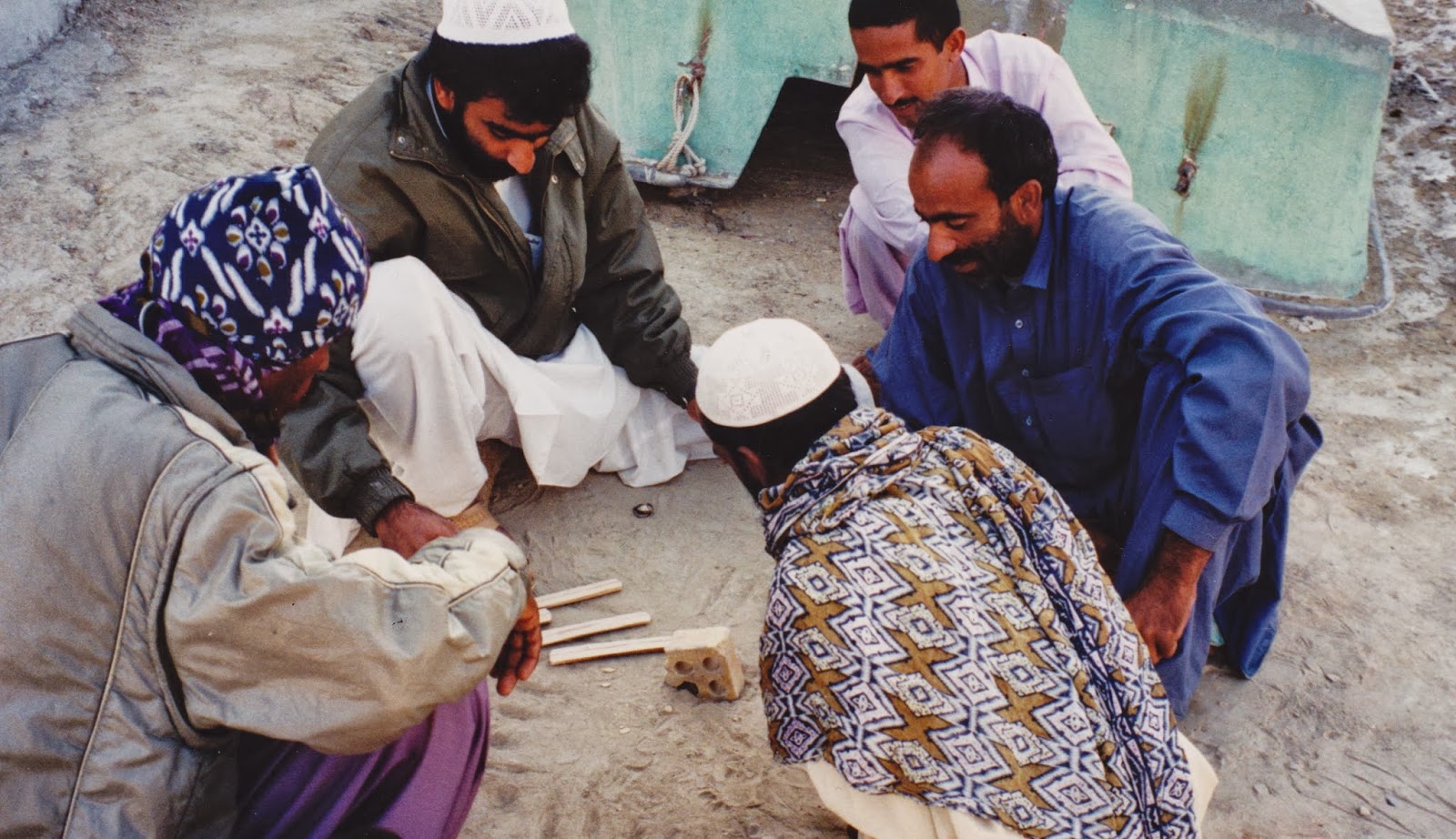
Chah Bahar has its Baluchi ways that were significantly different to most of Iran. Baluchis were mostly Sunni and their clothes harked more to the subcontinent than to the country’s west. The only difficulty, common to all port cities in Iran, hotels for foreigners were expensive. As Iqbal really was a nice guy, the three of us agreed to share a room, with two single beds and a mat on the floor for me, in between.

It was in that small period between the turning off the light and the sleep arriving, with the very last of the day’s chat winding down, when I heard one of the strangest sentences ever. We were finally asking Iqbal why he was in Iran. Through the darkness I heard him say, “I lost my jeans. I’ve come to find them.”

Politeness says a small reply is in order, something along the lines of “oh, that’s nice” or “I hope you find them.” I don’t recall if I managed to squeeze something out, but I was entirely grateful for the darkness – nobody could see me biting hard on my lip to prevent laughter from bursting out. It was helpful that I couldn’t see Lachlan’s face at that stage, because I knew he would be having great difficulty holding his own laughter back. But the silence – it was no longer a negative waiting to be filled – it was substantial, unbearably heavy and with the force of a category five cyclone. That silence couldn’t be resisted.

I heard the first busts from Lachlan’s closed mouth – and then we roared laughing, both of us – unseemly, rude and for several minutes, unstoppable. Iqbal didn’t understand what was humorous.

There were some obvious questions – why would a man lose a pair of jeans in a neighbouring country – had he been there before or were they somehow smuggled over the border? How regularly is it that people travel abroad in search of missing trousers?

When the laughter eased and we sought explanation it became apparent we’d misunderstood. It wasn’t his jeans he’d lost but his jinns. He’d sent them to Iran and they’d not returned. Of course, the concept of losing one’s jinns also raises some obvious questions – but it was better not to ask. It was time to sleep.

We took the plane on to Zahedan, the capital of Iran’s Sistan and Baluchestan province and not very far from the border with Afghanistan. Iqbal was with us – he was going the same way – and he was still a rather good and likeable guy. So we stayed at the same hotel.


If you ever happen to get shot in the leg, it’s certainly no excuse for interrupting a dinner party. Particularly if it’s a family birthday party and others are in high spirits in the hope of an entertaining night over a meal, then it’s better not to mention the shooting. As for the blood that’s dripping on the floor under the table, a fistful of napkins can help, and if it’s done discretely nobody need know. Then, once the meal is completed, it will possible to drive the wife and children home before quietly continuing on to check into a hospital.

It was the first moments in Zahedan that I started to consider that Iqbal might indeed have some kind of superpower. Lachlan and I had gone to buy water and I was discussing Iqbal’s flourishing communicativeness. I said, “He can talk on any topic. He could talk for an hour about his socks!” Socks was random; yet minutes later, back at the hotel when we went to find Iqbal to go sightseeing, he was just putting on his socks.


The best socks are made with thicker wool by Afghans. You can buy them at the Afghan market and other socks simply won’t compete – Afghan socks are warmer and more comfortable and never get holes in them because they are hand knitted. Once you’ve worn Afghan socks you’ll never wear others. If it’s not Afghan the socks aren’t worth buying.

Zahedan is picturesque with its backdrop of jet black hills. We took to the city’s photogenic suburbs with their mud brick houses. It was inevitable that in the mix of buildings we’d end up standing on somebody’s roof. What was unexpected was that the householder came rushing out and asked us not to stand there because it might collapse. Instead, he invited us to come in for tea.

We chatted with the Zahedani and he was rather impressed by our Farsi. For some reason, maybe his accent, we could understand him well while Iqbal struggled. “These two have come from the other side of the world,” said the Zahedani, “and their Farsi is good, but you come from a neighbouring country and you can’t understand.”


Yet he really was nice guy, Iqbal. So what did it matter if he’d lost his jinns? It could happen to anybody.


The story of apparel cannot be told by jeans and socks alone... There'd need to be...


                        various knitwear items in vomit green...


                                                                                         a sari shawl in alpaca, of course!

                                     the very latest in elegant, chic, forest wear...


This article also published in Star Magazine, here: Without the Window, It's Not Worthwhile

The Battle of Aleppo


Aleppo is in the newspapers.  Aleppo is in watering the houseplants.  Aleppo is the pigeon sitting on the windowsill.

It was on the bus from Qamishli that I first saw him.  By and large he looked as any passenger would, with the only distinction to his appearance being perhaps the keffiyeh in red and white check that he wore.  He was an Arab.  But the keffiyeh is common in Syria so even that couldn’t make him stand out in a crowd.

He may have had a sort of downy stubble that stretched down his cheeks but failed to reach the promise of a full beard, when I think of it, and from the thinness of his face his bones may have given a stronger outline to his features.  These traits, I suppose, lent him a look that was slightly avian.  But it’s easy to think such things now.  When he took his seat on the bus which was, by happenstance, next to mine, there really wasn’t any clue he was a man of the birds.

To read about, Aleppo is a war zone: a battlefront of street fighting, bullets and shelling, a growing list of human casualties.  But in the days of Hafez al-Assad when, in terms of daily life at least, normalcy seemed to prevail, the battle of Aleppo wasn’t that.  In those days there was a different type of battle, more of the feathered and wing variety, and it was limited to the rooftops and the Aleppite skies.  It’s that earlier battle that’s been waged in Aleppo for many centuries, the battle of the birds.

In rather broken English we talked and when I asked, he spoke of trading: a business of some modest arrangement involving the carriage of goods for sale from Qamishli to Aleppo, or more likely from across the Turkish border.  He spoke of his country, that once Syrians had been a people of great hospitality who prided themselves on hosting parties and socialising.  In more recent years, he said, the culture had changed, with the sense of community weakening in part due to higher prices and living costs.  Few people thought much about hosting celebrations any longer.

But it wasn’t these topics that engaged him and before much time went by he spoke instead of his passion, his pigeons.

When the bus reached the city I saw he was a man of boxes, unloaded from the undercarriage onto the footpath and likely of Turkish origins.  I asked how to find a hotel; it was already late.  He said if I wished I could stay at his house and I said if it would be no trouble I might just do that.  Or at least I tried to say that in singular vocabulary.  It was fine to be invited: perhaps he was in a small way recreating that older, more hospitable Syria.

His apartment was in an old building, sandstone-like and of the type that sort of half-says Aleppo is one of the world’s oldest continuously inhabited cities.  Inside it had a broken decorative railing to its stairwell.  He showed me to a metallic framed single bed in a longish room with a window at the far end.  I gather he usually slept there but on that night it became the guest room.  From the journey I slept easily.

The pigeon man (centre) with pigeon trader and his friend

It was in the morning he took me to the rooftop.  I found a space of perches and nesting boxes with a sizeable aviary on one side.  He introduced me to his pigeons, pointing out the special or rare ones that I have no hope of describing now.  They must have been of a different breed, with fluffier feathers or a fashionable colour.

I’m not sure why but that morning he’d shaved the downy stubble off his cheeks.  It can be that the stubble was a kind of feather-like reminder for when he travelled only, or he may have wanted to look his best for his birds.

He explained how he let his pigeons fly freely most of the time and tried to make their home aviary as comfortable as possible to encourage them back, and to encourage newcomers.  He showed in the sky that circling pigeons were an Aleppite signature.  Holding one pigeon in his hand, he held it up and then quickly dropped it down a little, giving rise to its instinct to flap its wings.  Still in his hand it flapped with vigour and I heard that this was another way to attract new birds to his rooftop.  It was the aim of every pigeon fancier in the city, to capture the best of the flock, in the more traditional battle for Aleppo.

I wondered at his enthusiasm.  It’s not that there aren’t worse hobbies, but what did it matter who had the best pigeons in the city? 

It seemed unusual how content he was to sit for several hours on that rooftop with his birds, how much anticipation there was for the day’s expected visitor, a pigeon trader.  I wanted to explore the city but I sat there too, in part enjoying the unusualness of finding myself on an Aleppite roof learning about pigeons and in part wondering what was the correct etiquette: when was too early to politely excuse oneself from pigeon adoration in order to be a tourist?

Eventually I took my leave to visit the city.

With not more than a few pots in the apartment in Dhaka it’s hardly a garden I have.  Each plant struggles through the periods of disinterest, wilting in the days and weeks of inattention drought; but they sprout anew when I decide to like them again.  It’s in the latter periods when Aleppo comes to mind.  When a leaf is worth taking note of, when a stem marginally lengthened is pleasing, it becomes easy to appreciate the man who loved his pigeons.

I wonder what he’s going through now.  


Disclosure: Author wishes to acknowledge having pet birds in the past.  Notwithstanding, there was never a pigeon man’s passion to it.


Syrian music band from Ottomon Aleppo in the 18th Century (image: wikipedia)


From birds on the roof, to accidentally farming buffaloes, or enjoying a little rodent tourism, or even running away to live with the kangaroos, animals keep us busy.


This article also published in Star Magazine, here: The Battle of Aleppo

Larnaca, Salt of the Earth


Sunlight
The Sky was blocked in the east by the bookshelf apartment blocks of the compact city once called Kittim.  As books row by row, side by side, people live: storage functionality for the ones commuting through the twenty-first century, life in lung enough still to taste the Mediterranean salty Air.  Now they call it Larnaca, that city in Cyprus that from the Lake as though with some right covers the dawn light with its bushel.

They’ve made a little park for themselves, the Larnacans, moulded to match the eastern shore.  It’s a salad buffer between the tamed and dusty, the modern and the salty.  There’s a little forested path they’ve planted to stroll along in the evenings in striped tracksuits, up and down, relaxed in the certainty of the man-made logic afforded by such a sculptured path as that.  From there are they deck-chair foremen, surveyors of the scenery across the Lake.

They’ve done all this before of course and the Salt of the Earth, the little Lake laughs to watch them.  No, this is not the first time.
Nature and City
The winter grasses know their mortality, they shall be for such a short while of the Sky and the Soil.  Yearning for turning Breezes to throw open their future generations, to disperse.  Birth and death and birth: the Salt of the Earth, the little Lake nods.

All lands are ancient but Cyprus was made on the first day, so it would seem, to be trampled and crushed to dust by the feet of the ages, the sheep’s hooves and goats’ hooves and wanderers and travellers in sandals or barefoot.  Through the centuries they came, laden with armour or vulnerable in light cotton, to conquer, driving their flocks, to pray and sustain themselves.  All History seems to belong here and that little Lake saw it.

Grasping the wind
To the north are two millennia in Stone, Roman, where ancestors laid slabs, raised columns and affixed arches in an aqueduct, for that most primary purpose of water-bearing.  Just as the Larnacan Sun rises in the Greek language so once it did in Latin, as the people of a small Roman town went about their business, at the market, to school, to the houses of relatives, in the shadow of that aqueduct.  Their thirst is gone; their water-bearer is all that’s left.  The Salt of the Earth heard the Water gurgling and knew their transience.

Flora and fauna
To the west are the undulating spaces for the flocks, an untamed and woolly landscape.  The sheep as they wander follow these patterns, plucking grass, crushing dirt, gathering ahead, socialising, grazing and conforming.  The sheep are of many directions but only one future, that of all generations.  Their shepherd watches their progress, conducts their circular movements in moments in the hours of days of salty Wind currents and beating Sun.

Thirsty Romans

Salt


Time has stopped in that shepherd’s grassy-tussock tradition, but to the Salt of the Earth he is not more than each speck of sand that remembers how things were, how they have always been.  The little Lake has watched the flocks for many centuries: birth and death and birth.

Umm Haram, the wet nurse of Mohamed has a shrine to the south-west.  In her old age it is said she had fallen from her mule and died, during the siege of Larnaca; or was she found later by that dervish Hasan?  The Lake knows if people have forgotten the exact events.  By the Lake’s edge at Hala Sultan Tekke she was buried, as though hoping to join in the Lake’s unending quality, to surpass even that.  Did she find eternity, by the grace of Allah?  Maybe she did.

The Flock
And like the Salt of the Earth she is preserved in the world, to an extent, as witnessed by pilgrims who have over the centuries arrived at Hala Sultan Tekke to pray and consider the mortality of their own.  There they took hope and consolation and blessings, on the south-western shore.  Once there were Christians and Sunnis both, revering her graveside, at the quiet place within the walls of a medieval garden.

Many directions, one fate
Now of course Cyprus is divided, the walls are between them and within them: Turks in the north, Greeks in the south and the pilgrims to Hala Sultan Tekke are few.  The Christians don’t go and the Muslims can’t easily go, for the cross-island fence and the guard posts and the machine guns that protect them from themselves.  Because the ever-witnessing hills of Cyprus are not the ever-replenished plains of Bangladesh.

And beyond even that there’s futility in it, the shrine: for the Salt knows it will outlast even her shrine: the preservation of Stone is not the same as the eternity she may have elsewhere.
The Gate
To the south is the airport that brings northern Europeans in their thousands to lay about in deck chairs on Larnaca’s beach.  Their busy lives of shuffling to work and home and daily chores in the darkness of winters are paused in pursuit of the Mediterranean Sun.  It brings Bengalis too, that airport, the ones that congregate in the squares of the capital Nicosia on Sundays, who’ve come in search of work or education.  In the distance the metallic bodies of the plane-contraptions, the tips of wings and tails squint and glimmer.

From the East
The Salt of the Earth laughs to see them: for how long? For how long shall it be before there’s a new age, a return to the wooden sea-craft of earlier times or something else?  The only surety in civilisation, the little Lake knows, is birth and death and rebirth.  The Salt of the Earth sees how they pretend to know what they do.
Courting the sky

Stillness
It’s not beside the Lake but in Larnaca town that empty tomb; but even at the Lake is the presence of Lazarus of Bethany, the first Bishop of Kittim.  He was in Cyprus for his second death, before his second corpse was captured for Constantinople.  Jesus of Nazareth had rescued him after four days in his first tomb, so it is written, the story of Martha and Mary and Jews in mourning; and it is said he fled to Cyprus in fear of his second life.  But of course that too came to its end.  Did he find eternity, by the grace of God? Perhaps he did.

Silence


And yet it’s not around the Lake’s edge nor in the town that has the final say, but in its middle.  What sort of God was it that painted the flamingos pink?  How was it decided to initiate their migrations from Africa, to Cyprus, to Africa again?  How were those routings plotted, coordinates decided?  Who understands avian ways?

In the cycle of life the little Lake on the island of Cyprus, Salt of the Earth, rejoices in the ludicrous brilliance of flamingo feathers.
Peace


But the world cannot only be about salt.  There might also be a bit of sugarwater and silt.


This article is also published in Star Magazine, here: Larnaca, Salt of the Earth

Swimming with Osama


Bandar Abbas, Iran (photo:wikipedia)


Does Osama like to swim? Yes he does. If it was more wading and paddling or arms stretched to the front parting the water like morning curtains I can’t recall, but he certainly had no fear of water. There was no hesitation there: that is true, for I swam alongside him some years back, in 1997 by the settled calendar of the west, to be exact, to be precise, in the mountainous wilds of southern Iran.

The water was mineral stained, the blue at its least a mix of cobalt glass, peacock-chest and Swedish-eye. It was other-worldly, a blue that must’ve shamed the sky even in its brightest effort, such that the regular concealment of night would come as an entirely welcome cloak to its failure. The water was warm, Earth-baked and a suitable adversary for the cooling evening air, when we arrived in that furrow of a gully in those rocky and harsh mountainsides.

Marco Polo had been there, so it is said, to the place called Geno outside the Persian Gulf port of Bandar Abbas. It can’t have offered much physical comfort on Polo’s way eastward to China: there were no silkworms there to weave for him some bedding, no emperor’s court on-site to entertain and in all likelihood not a single campfire in wait for the roasting of a meal. Geno is rugged and unsettled, but at the very least it surely brought a certain measure of wonder: the traveller’s treasure. And if it was that, like Osama, in Geno he swam, I couldn’t say.

Fishing the Persian Gulf (photo courtesy Iran)
The stars were sewing their tapestry across the heavens by the time we were drying ourselves in readiness for the drive back to town. The lateness of the hour was Osama’s fault, and Osama’s mother’s: for the Osama family had all the hospitality of that country where the locals say, ‘guest is God.’ The lateness of the return was the lateness of the setting out, after a meal, quite possibly of kebab and that long, delicious flatbread the Iranians also call ‘nan’, quite probably taken while sitting in a circle on a carpet on the floor. There had been so many meals like that so the specific details of that one have become elusive.

To be sure, it wasn’t at all to be considered in Iran, the country of crystal finery and etiquette precision, to be setting out for the springs without the prior satisfaction of food.

1997 by the settled calendar of the west, to be precise, to be exact: it was the days before Bin Laden’s infamy, and this Osama was not him, to be sure, but a young Iranian guy who’d met my school friend Lachlan and I by happenstance on a Bandar Abbas street on our way travelling through Iran. It was the first time I’d heard the name, and I liked it: O-sa-ma. It’s quite pleasant really; in those days when there was no connotation to it, and even now it can hardly be said to be a name of any less fortune than ‘George’, with apologies going to Mr. Harrison, Mr. Washington, Mr. Clooney, Mr. Costanza, Mr. Jetson and the others: sadly, your name has been cooked.

Bandar Abbas has a Portuguese history, with burqa-clad women sporting red or black masks across their noses and around their eyes; a masquerade relic of Portuguese fashion from centuries gone that went native along the Persian Gulf coastline before the colonisers left in their ships. The odd thing was that with the additional facial covering uncustomary in the rest of Iran the local women’s ankles were bare, less covered than in the rest of Iran, so in a sense it evened out.

Persian Gulf fishing trawler (photo courtesy Iran)
And offshore on the island of Hormuz is the shell of a Portuguese fort, rounded and brick, in which a random Kurd from far north-western Iran cooked and shared his lunch with us; partly because his village lay near a remote and ancient Armenian church that we’d visited some moons previously.

Bandar Abbas has an African history: the locals there called Bandaris are of mixed African and Iranian heritage, the complexion darker and culture distinct. In Bangladesh, it need not be said, that the term Bhandari has created its own cartography.

Bandar Abbas is a Russian story, so it was said: such that in the days when the Soviet Union opened and the Russians first ventured beyond they would sometimes stop there on the way to or from the electronics haven of Dubai. So we’d accidentally become Russians too, Lachlan and I, for perhaps half an hour in Bandar Abbas.

For two months or more we’d been in Iran, and our Farsi lessons in Sydney had led us into a little game called ‘trying-to-convince-the-hotel-manager-we-are-locals-at-least-until-the-room-rate-is-fixed.’ It’s not that Iran was expensive; only that the game was fun.

When we’d been wearing local clothes, and with new beards in place (mine rather silly-looking), we could perhaps for a brief moment, with singular short questions and monosyllabic answers, pass as locals. And even my blue eyes were not totally inexplicable, for some Kurds share that blue. We’d try our best to arrive at a price, and then enjoy the hotel manager’s surprise as we handed over Australian passports.

But in Bandar Abbas it was assumed we were Russians, so we were, we were! The little stories, the little lies at the hotel reception: our Farsi was imperfect on account of our Russian-ness and we were engineering students studying in Tehran who needed a good rate since the Russian rouble hardly went far, did it? Why engineering? I don’t know, but we were not like their other guests, the moneyed Muscovites wanting to buy a new TV set and a video recorder in Dubai, that was the main thing.

Lady with Bandari mask (photo courtesy Iran)
We used to encourage each other in such endeavours, Lachlan and I, or lead each other astray. But it was Bandar Abbas and if the local women could mask themselves in red or black, then for just some minutes why couldn’t we do so with words?

They knew it was not so, those reception people, of course, of course; but they enjoyed the little performance, especially hearing us speak Farsi, in much the same way Bangladeshis now take muse from my inventive, original Bangla, if it’s to be described politely, which is what the Iranians would do.

‘So where are you really from?’ the reception people asked at the conclusion of the initial exchange. ‘Okay, Australia, but we really are students with no need for rich-country room rates.’

At dinner, a few hours, we got to know the hotel staff properly; for the hotel was hardly bustling and we were at least interesting guests. We relived the Iranian tour completed and re-listed the route ahead.


Persian Gulf (photo courtesy Iran)

Yes it was then: on the evening of slight Russian-ness before the Kurdish lunch in the relic of the Portuguese fort on the Island of Hormuz, on the day before the meeting with Osama and before the swimming in the pools of cobalt glass and peacock chest and Swedish eye. That’s the way, in accordance with the rules of true adventure, that calendars are written. Marco Polo would understand it: the other-worldliness and the wonder.


The Portuguese Fort on the Island of Hormuz, Iran (photo: wikipedia)


More adventure can be had searching for massive beasts or dealing with a non-English speaking travel agent or even just getting to work.

This article also published by Daily Star, here: Swimming with Osama

Russian Intelligence in Bengal


Mughal Painting, a Girl with a Parrot, from around 1580 (image from wikipedia)

‘How do they do it?’ I’d often wondered, back in the village in Hatiya, when villagers regularly seemed to know exactly what I felt whether I wished it or not. In the days when the heat was strong, without the benefit of even a fan to temper it, when homesick or down, annoyed or happy; when I’d try to do the Australian thing and push emotions deep inside so that, well I thought, there was not the smallest ripple left on the surface of my face, they knew. ‘They can see straight into your soul,’ I used to say, and it was true the day my aunt died in Australia and I’d wanted to ride for many kilometres on a rickshaw without purpose. On reaching the main town, the driver, who is my friend, took me to a restaurant instead, and though in those days, 1999, we could barely talk to each other, he ordered mango juice and muglai paratha, a fried egg dish, and things seemed a little better after that, as he rode home again instead of continuing to the ghat as I’d wanted and he’d refused!

I’d seen it with other people too. In those days when a boro lok, an important person, would wander into the tea shop the locals used to, out of politeness, get out of their seats and move to the back so the important person could sit front and centre. Often the local politician or businessman or whoever it was, even someone they’d never met before, would address the whole shop, and as long as what they said was sensible, more importantly caring, there was no problem. But, as sometimes happened, if they spoke nonsense or spent the time big-noting themselves, then while the locals would listen patiently, when the person left and was out of earshot, they’d say what they actually thought. It wasn’t always pretty, but it was pretty accurate.

The villagers, whether or not they’d been to school, had read widely, could read at all, had something. ‘Is there a loss when our lives are removed from the natural world around us?’ I used to wonder; and I don’t suppose I could say, but when they said someone was a ‘boro moner manush’ a big hearted person, one who was honest, good to spend time with, generous and compassionate, someone who would help the poor and disadvantaged, it was quite likely the biggest compliment they could give. It’s what was valued. There’s a kind of highly-developed Bangladeshi village intelligence and at its centre is the heart.


Wall painting of Nefertari (image from wikipedia)

Perhaps the Ancient Egyptians, something I learnt at university, would have fit in, in the village: they believed the seat of human intelligence was not in the brain but the heart. After death, in preparation for burial, Egyptian embalmers chiselled through the nose bone and using long, iron hooks and spoons, scooped out the brain, to be discarded as waste. Organs considered important were preserved and stored in Canopic jars for burial with the mummy; the most important organ, usually left inside the corpse, was the heart.

The emotional intelligence of the village, not to the exclusion of other intelligence but so well-developed, is striking. It’s not something I’d seen before.

Soon enough I’d be back on the plane; soon enough I’d be facing the yawn of the Sydney Harbour Bridge and the impressive sheen of the Opera House in a land dominated by cerebral intelligence. Were people in modern Australia embalmed after death, there can be little doubt those iron hooks and spoons would be turned on the heart, with all reverence reserved for the brain.

According to the concept of Australian intelligence, what matters most when valuing thoughts are position in life and the completion of formal education, for such things are simplified to equate to cerebral intelligence. Thoughts and ideas need a pedigree; they hold employment positions and graduate from tertiary educational institutions together with their thinkers. In educated circles, the weight of a person’s words and belief are measured almost exclusively along the logic lines of rationality. Words like ‘logical’ and ‘reasonable’ become synonyms for ‘good’, though they have no such meaning.

Emotions are easy to hide in Australia, everyone does it, and it’s quite liberating to be able to show, most of the time, just the image you want. Emotions are private, and a weakness; so supposing someone breaks down at a party, for whatever reason, they will certainly be led away to another room where their emotions can run in the company of no more than a few closest friends, while the party continues unaffected. Emotions are embarrassing gatecrashers at a public occasion; what in the Bangladeshi village is collectively embraced.

My Harvest Home, by Australian artist John Glover, 1835 (image from wikipedia)

The problem of ignoring the heart is that the ability to understand the human condition is altogether less; psychology is so underdeveloped it offers no meaningful substitute. With the simple lines of logic unrestricted, it’s easy to justify the unconscionable, such as Australia’s infamous treatment of asylum seekers over the years, or the massive loss of civil liberties that hangs from September 11. Australians who object to such things are easily dismissed as ‘bleeding heart liberals’, for the heart has no relevance.

Intellectual cerebral intelligence is compact and neat; it’s a straightforward system: add a few brush strokes of logic and all is fine, because there is no morality, no values and no vision; being free from these things is considered its virtue. It is after all a matter of simple science, and who could argue with that?

In educated Sydney circles, the biggest compliment might be ‘he or she is brilliant!’ which means they have a responsible job and the airs of someone with a few qualifications to their name.

And for me that would be about the extent of things but for a simple kitchen in a small Soviet-built apartment in eastern Ukraine, in the city where I was lucky enough to live in 2002. We used to sit there in that kitchen, my Ukrainian friend and I, with the constant companionship of delicious Ukrainian food and discussions, often heated, that could stretch from early evening until morning. My Ukrainian friend was as eager to know what someone from the other side of the world thought of well, everything, as I was.

One day she said she was having trouble with the English concept of intelligence, asking if it was solely cerebral. It took me by surprise, even after the Bangladeshi village, having never before properly questioned it.

She explained that in Russian, the language of that city, the noun ‘intelligent’, also to be found in Ukrainian as ‘inteligent’, meant someone who was not only good with their brain, but also possessed a certain refinement, a certain decency in their behaviour towards others; a respect towards not only other people, but all creatures. A type of intelligence with incorporated moral values is what she described.

According to the internet, the Russian intelligent is an educated person who comes from any class or background, with the term itself stressing democratic principles, thus making no distinction on the bases of class, gender or race. The term includes an ability to be flexible and self-sufficient, with a consciousness to the needs of others and a willingness to meet those needs; and a penchant to be truthful to one’s opinions and moral principles in meeting everyday life challenges. As a result of these qualities, the Russian intelligent often finds him or herself in opposition to autocratic government, and undertakes activities to help achieve enlightenment, education and the protection of human rights. In other words, compared to Australian norms, the Russian version of intelligence is an altogether bigger thing.

It is from the Russian indeed that English has adopted the term intelligentsia, but in English it is not really engendered with the full range of qualities outlined above.

In the House of Artistic Creation of Old Ladoga, by Russian artist Vsevolod Bazhenov, 1977  (wikimedia image)

So is it a matter of Russian intelligence in Bengal? Well, yes and no; Bengali intelligence is undoubtedly a unique creature, and a multifaceted one. In Dhaka in particular the intellectual cerebral intelligence has its sway, where formal education counts for a lot, where it’s well-documented how much emphasis parents place on the academic schooling achievements of their children.

But like the Russian version there is behaviour in it too; think of the bhadralok or gentlemen, a word that in Bengali combines a high education with gentility in behaviour, unlike the English translation with its greater emphasis on etiquette than education. Or is Bengali intelligence of the village, including the emotional intelligence that could easily be dismissed as something less in Sydney, as instinct or intuition, because there it is something less?

It may be that Bengal intelligence, uniquely, has a spiritual component. It’s not the ‘he does namaz or prayer five times a day so he is a good person, intelligent etc.’ Rather, perhaps something deeper, stemming from prayer or religious practice, regardless of the religion.

I don’t have a definitive answer, but in considering what ‘intelligence’ means in Bengali culture, one thing is clear. It cannot be wholly cerebral; else there would be no respect for Lalon Shah, and Nazrul Islam as national poet would be unlikely, given his lack of a formal ‘cerebral’ education; indeed in Australia there are no such icons attracting that kind of adoration. In Bengal there is something more.

The brain alone can delude as well as enlighten. In denying the contradictions and complexities of emotion and human tradition, well it’s not even that the answers are wrong; it’s that sometimes the questions are not even the ones worth asking.


Chimpanzee brain image (from wikipedia)

It's also worth considering if life isn't about a salt lake in Cyprus, a pretty river in China, or even an over-sized wheel.  Just saying.


This article is also published by Star Magazine, here: Russian Intelligence in Bengal


Bangladesh Dreaming: Article Index for articles about Bangladesh
Free counter and web stats