|
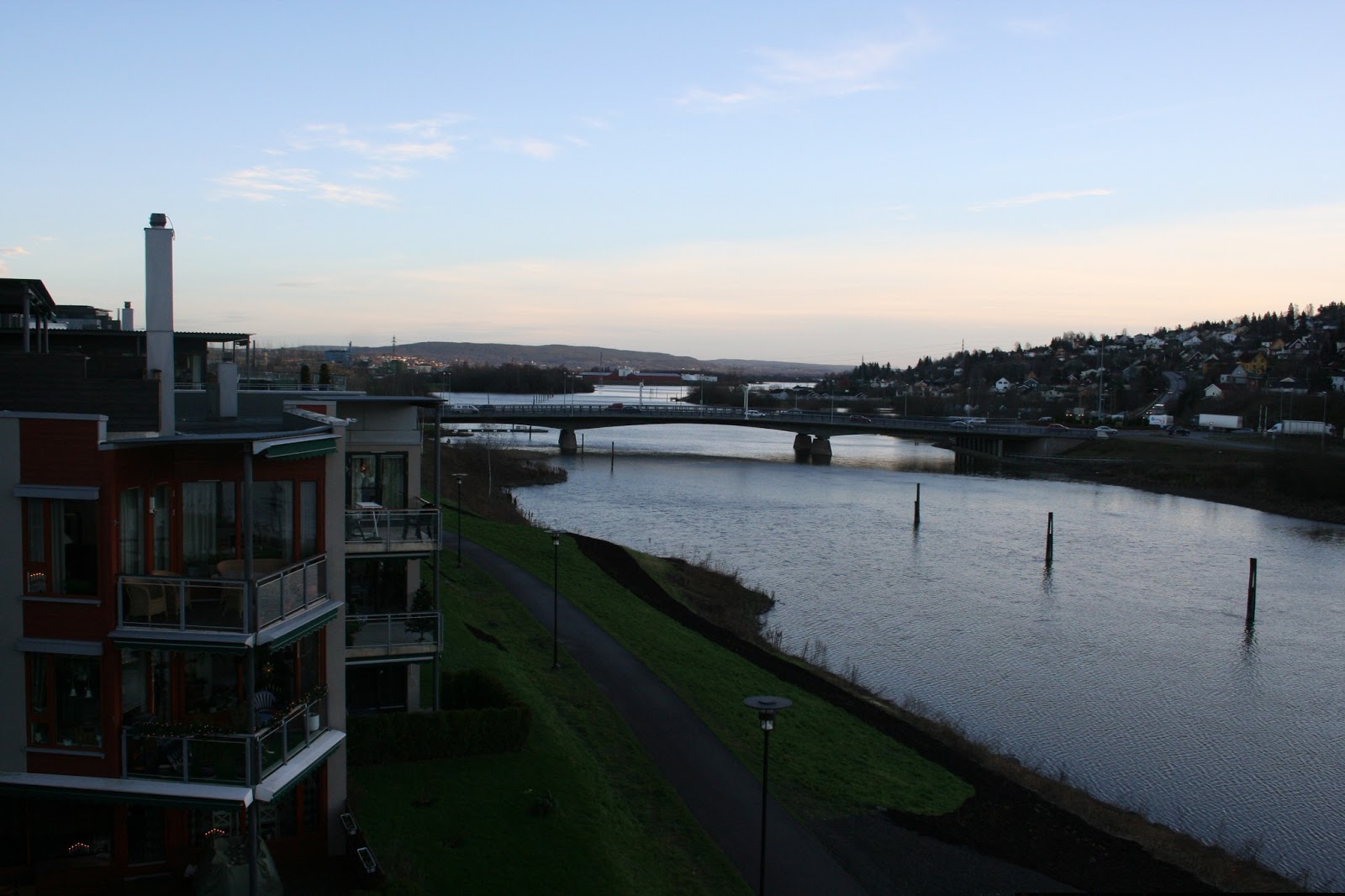
| Sunrise over the Nitelva |
Besides, just as the heart might be found unexpectedly inhabiting
some distant delta, the cogs of the brain might turn their first in a snowy land.
In the free hours in those initial weeks in Norway , at the zero point, I’d taken to
exploring and found that up the street from the Rælingen house suburban Oslo gave way to open
country which at the time of year was decked white. There were deep pockets in the landscape of
fields and in one I found an impressive oak tree. Against the grey skies of the Eastland the
stem patterns seemed to mimic the shades and arcs of light in the house and the
flicker of the candles.
There was a small pine forest and having grown up in a land
of eucalypts I was excited to clamber through it, up the icy slopes with a leg
occasionally falling deep into a random hole of snow. I had all the wonder that Bangladeshis do
when they say they’d one day like to see snow, and touch it.
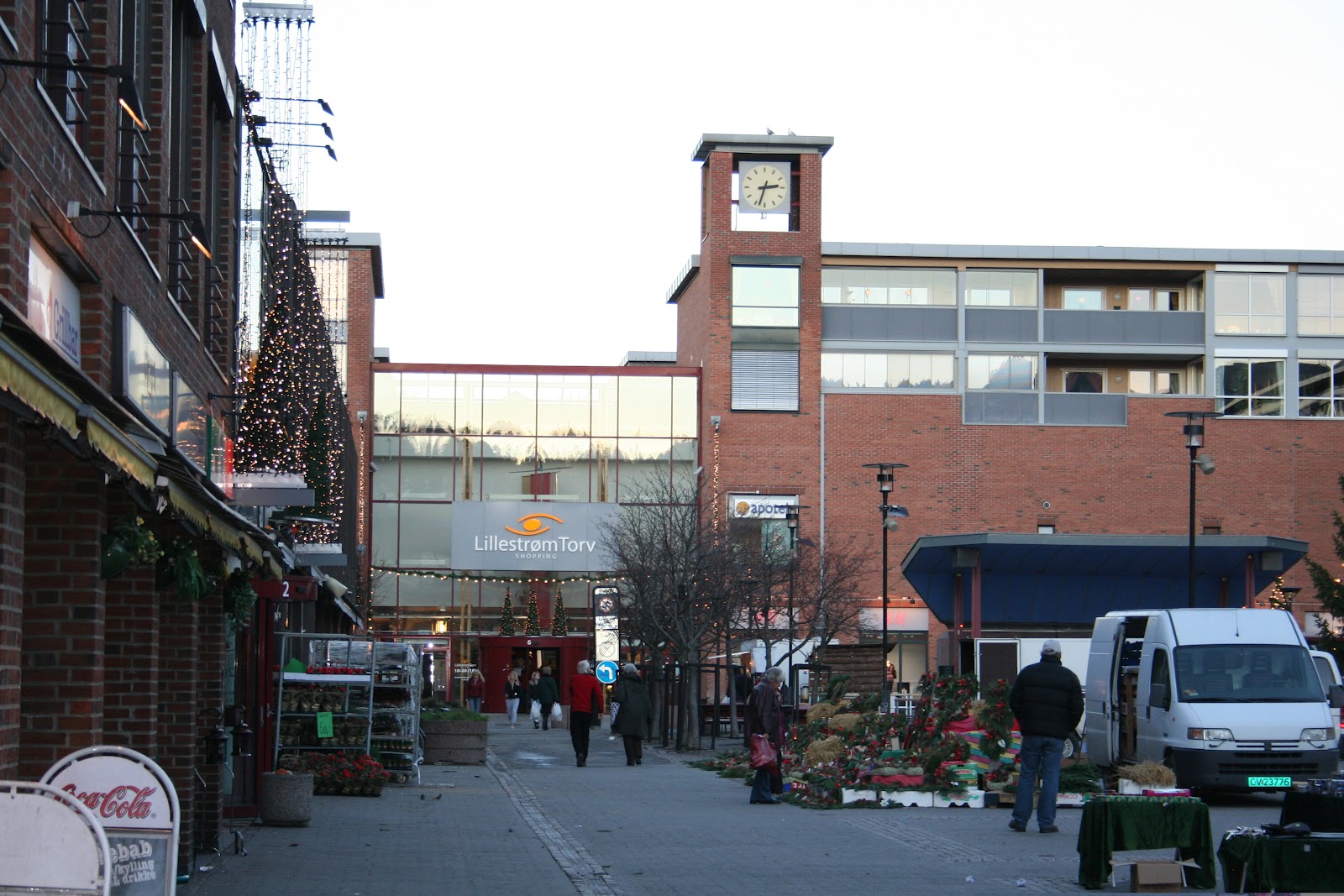 |
| Lillestrøm Town Centre |
I was wrong about Gunborg and Olav. Theirs was not a bingo existence; the
Rælingen house was no retirement village.
Perhaps I appreciated that best in the summer, because although I was
staying in the Westland by then I continued to
visit whenever I had the chance to reach Oslo
again. To my astonishment, that summer
Olav sprang about the lawn in his sports outfit. He leapt and stretched as we played the
badminton he’d proposed. It was tiring.
They were members of a swimming club so we’d swum; they
liked to walk so we went to see the wild birds in the river flats a little to
the south of Lillestrøm town. They were
members of a pensioner’s ski club and one day we all went cross country
skiing. I was part of a team with an
octogenarian leader and all other participants over seventy. There must’ve been at least some arthritis
for them to contend with, but the pace was altogether suitable for an
Australian skiing novice. Maybe it was
really me who was seventy.
Meanwhile the oak tree had been busily changing its dress,
not into a sports outfit but donning a light green hairdo for spring, a mature
deep green summer crown and a short-lived autumn cloak of yellow and
brown. It wasn’t only Gunborg and Olav I
came to visit in every season, but the equally active oak tree.
But I get ahead of myself.
In the initial days Gunborg and Olav, ironically, spent some amount of
energy concerned that I was bored, despite my saying I wasn’t. They proposed the museum trips and the
National Theatre for a play. They
organised for me to spend one weekend with their eldest son Torgrim and his
family; but unfortunately, because of the language difficulties, I hadn’t
understood that plan. Just as we were
leaving there was a sudden fussing because I hadn’t packed any clothes. I had no idea I needed to.
When it became apparent I wasn’t going back with them on the
same day, I was quite upset about it, though I said nothing. I thought I must’ve done something
wrong. I was sure they were bored with
me. And I don’t know what their son
thought because I was sullen and consumed in thoughts about what bad and
probably Australian thing I might’ve unthinkingly done. It was only when we went down to their tennis
court on the next day that it properly dawned on me, that they thought I would
enjoy the change. Their son’s wife Frøydis
asked, ‘Didn’t you bring your tennis shoes?
Didn’t they tell you we’d be playing tennis?’ So I played tennis, embarrassed, in bare
feet.
Eventually I challenged the Nitelv. With courage built I followed footprints
through the snow covering the ice of the river, thinking I could turn back if
the tracks suddenly stopped by a hole; yet without incident I reached the far
side. My Australian parents would’ve
been more than a little concerned; but Gunborg had watched calmly from her
kitchen window. She knew the exact
temperature from the thermometer affixed outside the glass pane and from past days
she knew the ice was thick.

Walking on ice was a skill to learn, not only on the Nitelv
but on the footpaths too; and it came in handy, later, in Hatiya, when fearlessly
negotiating the muddy back roads of the monsoon. There’s something similar about the stepping
lightly and placing your body weight with care.
There was one morning they managed to tell me to be sure to
take warm clothes as it was six degrees.
I thought I must’ve misunderstood.
Six degrees was hardly that cold: a winter’s night in Sydney might be as low. I asked several times and surely they were
saying ‘six’. Pleased, I thought I might
escape the full horse of clothes and sneak away to class in just a jumper; but
I didn’t make it three steps. In winter
Norwegians don’t always vocalise the minus in the temperatures, I learnt.
Of all meals in Rælingen breakfast was my favourite. We ate slices of brown bread with paté and
gherkins, herring in tomato sauce, Gunborg’s homemade apple jam, cold meats and
cheeses: there was Jarlsberg with the holes, ‘key’ cheese with the little
crunchy brown pieces in it, goat’s cheese and the soft caramel tasting brown
cheese for which Norway
is famous. We’d swallow a teaspoon of
cod liver oil washed down with milk, orange juice or filter coffee.
The evenings shared were often given to pointing at things,
with me repeating the Norwegian name; not unlike what would later occur in the
tea shops of Hatiya as the villagers taught Bangla. Sometimes we used dictionaries and Gunborg
made sure there was a pad by the kitchen table to supplement with doodles the
communication struggle. I practiced the
basic phrases from class and learnt new vocabulary. They also asked things: Olav once enquired if
when one had had enough to eat it was possible to say, ‘no thanks, I’m fed
up.’ It was the dictionary that divulged
why Gunborg’s food was as it was: she’d spent her working life as a home
economics teacher.

And it was truly remarkable to have these new, varied and
detailed Norwegian memories. I’d even
seen Ingrid from their optometrist business, a tradition their younger sons had
continued, appear on a love match TV game show and I hoped she’d find someone
nice. It was strange that I cared about
anything so specific occurring at the far end of the world.
I used to wonder about the simplest differences: the thoughts
behind the habits and the décor of Rælingen.
Why was the Norwegian concept of how a room should be altogether
different? How had light taken its
Norwegian meaning? What of more complex
ideas?
It is the caveman drawings of my thoughts I write of, the
zero point. Thoughts are culture shaped
and predictable most of the time; they’re barely ours. But in Norway there were thoughts in the
curtains, in the spreading of butter upon bread and in the lacing up of boots
by the door: new thoughts to be had, everywhere. And those first days in Rælingen were for my
thinking as the fabled first primeval steps of prehistoric animals, from the
swamp onto the land.
Sometimes I consider that although my body had been born in
Sydney eighteen years earlier, my thoughts are creatures of the icicles that
crunched underfoot and dangled from the lampposts at old Fornebu Airport, in
Oslo, on that first evening when I met Olav.
As it happened, like the Brahmaputra's, my journey started with ice.

** Photos from later visit in Autumn 2006.
And speaking of the Clauses, there's no forgetting the brave fisherman, the mother bear from Goldilocks or the riders from the north.
This article also published in Star Magazine, here: Zero Point
Norwegian Light: Article Index for articles about Norway
And speaking of the Clauses, there's no forgetting the brave fisherman, the mother bear from Goldilocks or the riders from the north.
This article also published in Star Magazine, here: Zero Point
Norwegian Light: Article Index for articles about Norway