Showing posts with label river. Show all posts

Reminiscing with a River


O Mamoré, generous sustenance giver, tributary, great earthworm of a river: I see you from above, pushing off and pushing on, northwards flowing, northwards growing, like an uneven, winding hem across the landscape. I see you from the plane, ever the direction shifter, you turn and return, loop and loop once more – almost full circle, several times, before you go about switching course again. Of the Beni, of the lowlands of Bolivia’s east you are a lifeline: the cargo boats ride you as their highway while as ecosystem extraordinaire you shelter creatures – in you the pink dolphins find their home. And with these important tasks, I ask, is it any wonder that as you weave across the savannah you are as commander of the Moxos Plains? What a view! O wild and majestic Mamoré, I know it too, that beyond the horizon the Amazon waits for you. So, below the patchy cloud in the day’s midst I see you twinkle as though winking at the sun, as I ready to re-embrace the jungle heat, as the tiny plane like a careless sparrow drops from the sky – and in, to land, at Guayaramerín.


O Mamoré, do you remember when we met? It was as that open-air truck, the camion from remote San Ignacio de Moxos, cautiously sidled down your muddy bank trying not to overturn in a rut, as it took to the ferry on its way eastwards to the Holy Trinity, Beni’s capital, La Santísima Trinidad. As you well know that was towards the end of the few-hour journey, for of course Trinidad was first established on your very bank, until, it seems, you tired of the dizzy distraction of the town-dwellers and urged them on, was that it? Through flooding and disease you pushed them back, not far, to relocate in 1769. What you might not know is how in the wild ranch-and-mission country of San Ignacio that morning I’d gone to meet the bus only to be confronted instead with that camion, arranged with loose-fitting wooden plank benches to sit on; and it was before we met I faced the dirt highway. But there were blue and yellow macaws in a towering dead tree and caimans lying in the open by the ponds in the cattle paddocks – not sure how the cows could drink there beside all those teeth – and rheas, those South American ostriches, with purpose they went strutting through the grasses beyond the road – and to find these animals without even trying made Beni seem a wildlife wonderland. So it didn’t matter about the patchy rain that fell on us or the dust kicked up that teased our eyes. When we met, if I wasn’t smiling it’s because the wooden plank seating, after hours, bumpy road, does little good to the posterior.


O Mamoré, what do you really think of Trinidad? The low buildings around the central plaza, the palm trees and the melting in the day’s heat, is it to your liking? It can be the sound of the town – the groan of pick up trucks and the buzz of moped and motorbike that swarms the air is unsettling but the Benianos are resourceful people, in tank tops and jeans, removed from the centres of Bolivian power in the Andes, neglected they may say, and proud of their lowland camba Spanish and their camba culture that inherited more from El Andalus than from La Paz. And I need a hat for the sun is fierce. Do you know that in the evening when the locals promenaded and moped-buzzed around the plaza I pondered how it would be to run a little English school there?


O Mamoré, tell me how it was, the Beni, for you saw the Spaniards arriving late, one of the last blank spots in South America on the European maps. You knew the pre-conquest civilisations, the people without a name who built vast canals and mounds across the savannah in a system of agriculture unique to the Amazon basin – they fooled the scientists, didn’t they, who thought that because Amazonian soils are infertile, despite the jungle, humans in any numbers could not subsist there. Isn’t it strange how they’re trying those old ways again, the farmers growing crops on mounds, raising fish in the canals, facing the annual flooding with that prehistoric methodology that reduces the need to slash new areas of jungle every few years when the soils become depleted? You saw the indigenous peoples who came later, you watched as they faced the missionaries and their languages merged, as diverse groups they were reduced to the singular Moxeño people, old ways forgotten. Did they really benefit from Christianity? You saw the nineteenth century rubber boom and best of all you must know the truth of El Dorado: that legendary city of gold that many a fortune-seeker staked their future on, the city that was never found. But perhaps the only El Dorado was always, rather, the twisting and turning you!


O Mamoré, do you remember my little adventure in Guayaramerín? You’ve become the Brazilian border by then, isn’t it? And apart from that little disputed island it’s clear that on your far bank the Portuguese starts, in the Brazilian co-town called Guajará-Mirim. So I took the boat, do you recall? I saw how broad and fine you are –and from the heat I wished to, ill-advised, dive into you. There was ill-ease, did you sense it? I’d read I could enter the Brazilian town for the day without a visa and return but it wasn’t certain what would happen. I tell you, when I went inside the immigration building on the far bank I paused with a kind of dumb, innocent smile waiting for the official to acknowledge me, wanting to humbly ask if Brazil wouldn’t mind much if I slightly entered its territory for just a short while. The official quite deliberately turned his back which I took as quiet permission to wander past the desk and out onto the street – I’m sure that’s what it was about – overlooking the formalities, just as he’d undoubtedly done for foreign tourists before. I liked Brazil for that, not hung up and welcoming. Guajará-Mirim was not by appearance so different from the Bolivian side, as you know, just an outpost town in a remote pocket of that other country. It was hot, more than hot, I needed water and the shops were closed, even if they would accept Bolivianos in payment.


O Mamoré, I found a mid-range hotel, for water, not to stay, and inside there wasn’t a soul at reception but after some minutes a uniformed maid, attractive, came, and all I could say, the only Spanish I found, that I knew, that she would understand was ‘agua’ – water, aside from the hello and thank you I managed in Portuguese.  She took a bottle from a trolley, a bottle that must’ve been destined for a bar fridge and I only wanted a glass of tap, and I showed her, I couldn’t pay unless she would take the Bolivianos she didn’t seem to want. She put her finger to her lips, O Mamoré, it was secret, without language, between us – and there wasn’t much I could do. I was more than hot and more than thirsty – she could see that. Back at the riverside I boarded your ferry to Bolivia and again the Brazilians overlooked, didn’t mind, and I really admired them. It’s the sort of thing that’s beyond Australian comprehension. I imagine you admire them too.


This article also published in Star Magazine, here: Reminiscing with a River

The Nitelv and the Oak


Did you hear what the oak tree said to the river?  I’d be lying if I said I heard it but neither would it do not to mention the river and the tree as they are a part of it too, do you see?  The threads of life are many and there’s one, not one but a big knot of events in amongst the wire cage branches and out on the white icesheet looking up in wonder at an ordinary grey Nordic sky.  You won’t understand much at all without the Nitelv and the oak.  You won’t understand my Hatiya without my Norway.

In the low hillocks above the small river that oak tree guards a gully beyond the suburbanised streets outside Oslo and from its enormous, watchtower trunk branches radiate upward and then, spindly and thinner, shower downwards once more in a lattice network that gives to the tree its overall mushroom shape.  That tree must’ve witnessed things: the carving out of small plots of farmland from around its position, the retreat of the pine forest to the tops of the hills, the replacement of deer with a few cows or sheep feasting on the newer grasses that colonise the cleared space of the paddock when the summer comes.

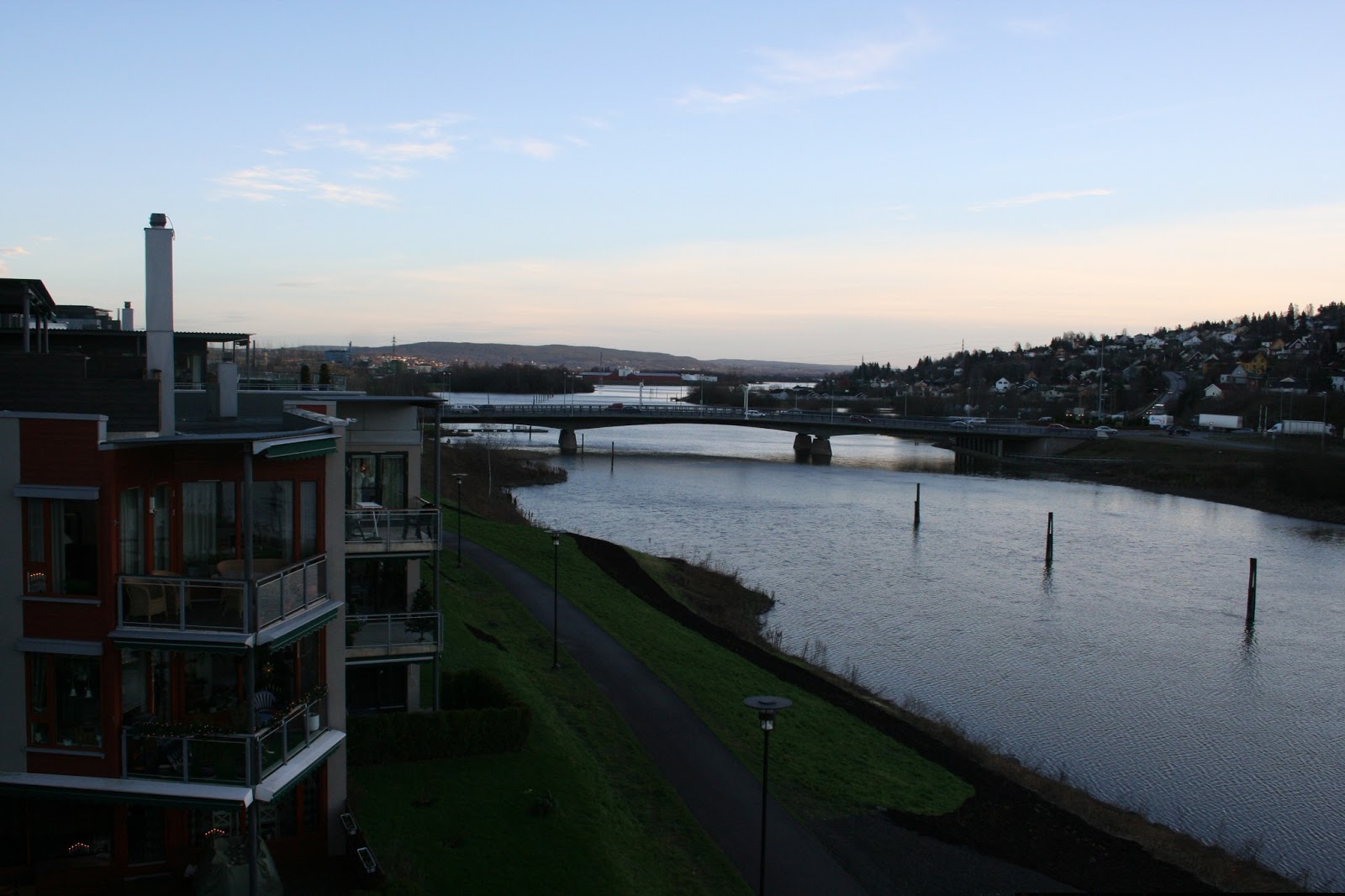
The Nitelv meanwhile cannot be seen from the oak but it’s only over the nearest hills in the broader valley, and the small river is also an historian.  On its flat marshy lands that were once the habitat solely of summer reeds and wild ducks a minor town came to settle, when in the nineteenth century a steam powered sawmill encouraged the populating of the river flats by workers.  Lillestrøm was founded.  These days it’s a satellite town of the capital, Oslo, and alongside the collection of apartments, stores, the culture centre and buildings of civic administration that look a bit 1970s Nordic, amongst the older wooden cottages, there’s a fast train service to the airport and a ticket on it costs more than Situ’s budget for half a trip to Ukraine.

In summer the greenery of the parkland and bike paths along Nitelva’s banks bring cheerfulness to the long evenings.  The sunshine is warmer at that time of year.  In autumn white swans paddle the blackened ponds just out from the deadened reeds nearest the shore, now brown and newly covered in frost and by winter the Nitelv is frozen silent and layered with snow.  It was winter when I first saw it.  Each morning, so it was, I’d resolve to walk across the winter’s Nitelv instead of using the bridge, on the way to Norwegian class.  I’d seen it done in movies, walking across frozen rivers although for me the opportunity was the first of its kind.  But I was worried about falling through a hole in the ice and drowning as also happens in movies; so I hesitated.

Aha! To hesitate is not the story of the oak and the river.

But it was between the two on the Rælingen bank that stood the first Norwegian house.  From its kitchen there were views across the river with Lillestrøm beyond.  There were views further too, as there always are, that our eyes are unable to master, away downstream to the grazing buffalo of Thailand and a hilltop quarter-mosque in the green scrubby jungles of Assam, away downstream to the yellow and red cherries in a water cooler bottle in the steppes of the East and to the pungent steam of stargazing in the vast treeless plateau to the South, that plateau fresh with mud from the unusual event of rain.  There was the view too, of course, to a shack on a strip of road on an island: all the many oak and river aspects, do you see it? 

The first Norwegian house isn’t there anymore.  The land on which it lay was resumed, the apple trees in the garden gone for the building of the high speed train link.


I really don’t know what the oak tree might’ve said to Nitelva, calling out across the few hills between them.  I speak neither oak nor river, so it is, but they must’ve had some interesting conversations over the course of centuries. 


Article Title: Classified


Karl Marx Avenue (Wikipedia Sourced Photo)


[Important: Do not read this article unless you are authorised to do so.  I repeat, do not read this article without proper authorisation.  If you are unauthorised, please exit the page now.]

“Always think of what is useful and not what is beautiful.  Beauty will come of its own accord.” – Nikolai Gogol.

They weren’t marked on rail timetables but the train would stop there.  There was no indication on bus routes apart from the name of a tiny village nearby or a kilometre marker.  There was no demarcation on publicly available maps and as for postal delivery letters and parcels had to be addressed with the name of a nearby city as a code.  I’m referring to the cities that didn’t exist, the cities where residents underwent security checks before moving in and were sworn to secrecy thereafter concerning their classified addresses.

What follows is advice for the traveller: what to do when facing that particular predicament of having nowhere to stay in a city that sort of didn’t exist.  Secrets can’t substitute, after all, for a watertight roof and a pillow.

During the summer I reached that “place”, the one that, well, I’m not entirely convinced I should name, but as it’s acknowledged and open these days I suppose it might be okay to write it just once.  Wait.  It might be better to put it in square brackets: [Dnipropetrovsk].

Home to over a million people, that place was once a key centre for the nuclear, arms and space industries of the Soviet Union, the reason it was closed to foreigners until the 1990s.  It’s an attractive place, or non-place, set on the meandering bank of the majestic Dneiper River that roughly divides Ukraine into east and west.  It’s a location of slight undulation surrounded by rich agricultural land of the sort that led Ukraine to be referred to as the bread basket of the Soviet Union

The “city” itself is a typical Soviet showpiece if slightly more polished than average: it has its Lenin Square watched over by a Lenin statue; the broad tree-lined, tram-lined Karl Marx Avenue is there, at several kilometres in length; and the Karl Marx traffic lanes are separated by a parkland strip where artisans set up easels to sell paintings and stalls for handicrafts, and there are benches for loitering and street food to enjoy.  In summer the Karl Marx strip has a fairground quality.  In another park is a collection of old Soviet tanks. 

That “city” is the third in Ukraine to have an underground metro and it might’ve been one of the privileges that closed cities enjoyed.  Residents of closed cities were given salary bonuses and better housing in Soviet times.  But by 2002 when I was there, it wasn’t the city’s former secrecy that was the problem as much as a lack of reasonably priced hotels.  It was a difficulty shared across Ukraine, where the break-up of the Soviet Union seemed to have been easier than the break-up of Intourist. 

In the Soviet Union foreigners were restricted to state-run “Intourist” package tours and in each city would be at least one, generally enormous, state-run Intourist Hotel to cater for them.  Those hotels were still running and remained grossly overpriced with the cheapest room for perhaps US $50 per night and with that "city" having been a closed city there might not even have been an Intourist Hotel there.  But even if there was, the room rate would have been approximately half a month’s salary for my Ukrainian teacher colleagues.  I stood on Karl Marx convinced that I shouldn’t pay so much either.  Rather, I contemplated what Ukrainians would do: they would not be staying at any former Intourist Hotel. They’re much too street savvy.

After a few moments the answer found me: Ukrainians would stay with friends.  Problem number two: I had no friend in that “city.”

After a few moments the answer found me: I did have a friend in Kyiv who I’d always thought was clever enough to devise a successful peace plan for Israel-Palestine if she sat down for a few minutes with a pencil and a notepad.  She’d certainly given an impressive speech once at the Toastmaster’s Club.  Perhaps it would be worthwhile calling her? 

I collected kopiyok and hryvnia coins from my wallet, knowing that public phones ate them rather rapidly and there’d need to be a good number in hand to push in at speed for extra credit.  I dialled the phone number and you know, when I think about that “city” I also start to wonder if I should name said “friend.”  Who’s to say she isn’t classified?  Although, as she does tend to use her own name, I suppose it might be okay to write it just once.  Wait.  It might be better to put it in square brackets: [Stacia].

‘I’m in [insert city name here] and I have nowhere to stay,’ I said. 

‘Call me back in ten minutes,’ [insert friend name here] replied.

It was as a Soviet storyline, standing on the footpath waiting for ten minutes to pass.  I watched the comings and goings and without reason tried to look inconspicuous.  Ten minutes later with a new bunch of coins in hand I dialled again.  The answer, when it came, was all but Soviet-perfect! 

‘There’s a Daihatsu on its way,’ aforementioned friend said, ‘It’ll pull up where you are within five minutes.’  Needless to say I’d told her where on Karl Marx I was; needless to say that in Soviet times it wouldn’t have been a Daihatsu exactly. 

In the allotted time said Daihatsu did pull up at said curb in front of me.  ‘Hi, I’m Julia,’ said the driver, ‘You’ll be staying with us. Get in.’ 

The first stop was a stilt platform café on the river for light refreshment, and I’m told that the bridge across the Dneiper is 1.4 kilometres long.  I’m told that Julia’s mother is quite distressed that she won’t be able to talk to me: she only speaks Russian.

Thereafter we reached the family apartment, one of the Soviet many; and Julia’s parents, Sergei and Lidia have thought of everything: keys to the flat, access to the fridge, phone number, huge dinner, toothpaste available on the bathroom shelf and well, beer.  It was wonderful!  Lidia needn’t have worried about the communication: she fired off rapid Russian and although I couldn’t distinguish a single word, somehow the overall meaning seemed to get through; or at least, the gist.  It was just like my friend Jayanta’s mother used to do in Bangla in Kolkata.

Ukraine is said to have had eleven closed cities in Soviet days, and in modern Russia there remain forty-two, publicly acknowledged, even today.  Some are surrounded by barbed wire with watchtowers, with special security permits to be presented at checkpoints to enter.  Around one and a half million Russians still live in those “cities.”

Before leaving, Lidia kind-heartedly gave me a book, in Russian, duly inscribed on the inside cover in Russian Cyrillic lettering, as a memento of the short time we shared.  Although I can’t read it or the inscription, to me that little book is priceless.  Well, I’m not entirely convinced I should name the author, but I suppose as he is internationally renowned it might be okay to write his name just once.  Wait.  It might be better to put it in square brackets: [Gogol].

[Important: Do not circulate or discuss this article.   Forget what you have read.]


A Russian stamp featuring that author.
from Wikipedia


Also classified are the National Secrets of Kyiv to the westa meeting with Mrs Val to the east, or a bit further still.... go swimming with Osama.  Because it's best to keep busy.


This article also published in Star Magazine, here: Article Title [Classified]

In Ink, On Silk

Indian ink and colour on silk, 11th century Chinese painting (image: wikipedia)


To state that the artist takes inspiration from the landscape is to say nothing in the way that stating the obvious is nothing.  But could there be a landscape that takes its inspiration from artists?  If there was such a place, it might be the countryside along the Lí Jiāng, the Li River in China.


In the sixth century, art critic and writer Xiè Hè documented his six principles of Chinese painting in the preface to his book ‘The Record of the Classification of Old Painters.’  The first principle, ‘spirit resonance’ refers to the flow of energy that encompasses theme, work and artist.  Without it, Xiè Hè remarked, there was no need to consider a work further.


It’s a house of camel hump hills, the banks of the Li, an arrangement of karst peaks and fog that’s become renowned.  The water currents flow simply, with humility and the mist of cloud and rain rises slowly to reveal the white and pinkish hues of the limestone faces of the mountains.  There is sadness and mystery in their cliff expressions: perhaps they are images of old age.


And the theme?  It’s up the viewer obviously, but might I suggest it’s about eternity?  It’s worth considering if long ago histories and, like serving tea, the smallest traditions that have marked China’s millennia, aren’t on display in the mountainsides, caught up in the banded, uneven cliffs and rocks.  The sadness might be the usual result of longevity; of change and reformation and change.  The mystery might be of an eon, ritual and repetition variety where seeming stillness is in fact gradual evolution.  The Li might be the very portrait of China?  The spirit resonance is there, no doubt, and Xiè Hè would not dispute the need to further consider the Li.

His second principle is the ‘bone method,’ the way of using the brush.  It’s about the marriage of handwriting and personality, and calligraphy and painting were indivisible in his day.  It’s the texture and brush stroke of the picture too.


From Guìlín to Yángshuò the tourists go, by boat they float along the Li.  It’s the critic’s route to admire the work, a vista dabbed softly with a fog and stone admixture.  It’s more than pleasing to the eye.  Each hill is unique, standing like an expert stroke of Chinese calligraphy, in ink on silk.  It’s about the texture.  It’s about the brush.  Each hill is deceptively relaxed and straightforward as can only happen if it’s been rehearsed a hundred times beforehand.  Only then can it become so natural.


The third principle of Xiè Hè is ‘correspondence to the object’ which relates to shape and line, the depicting of form.  The Li has incorporated that challenge too, in the gentle unexpected curves, horizontally in the river’s chosen path, its repose, and in the lazy line of the tourist boat, as well as vertically in the ridges of the mountains that seem purposefully to bring to the sky no harsh outline. Only a master artist could have captured such gentleness, could have thought to capture such gentleness.


‘Suitability to type’ is principle four, concerning the application of colour, layers, value and tone.  It’s a mop of green brush hill-hair, the banded strips of cliff in grey and pink and the opaque darkening of the fade-to-distance-summits that the Li offers in response.  Colour is in the modern faces in sunhats too, viewing the offering through a screen and talking in many languages.  They come from many countries to admire the Li.  Layers are found in the flattened smaller motor boats, historical, to be privately hired from one or other bank, and the tone is brought to life by the contrast between the red and yellow Chinese flag fluttering about the boat’s back that screams ‘here and now’ and the hills beyond which again, make all human resolve appear small and impermanent.  China was, is, will be: what the mountain-art might be saying.  It’s about an older China, an old woman and an old man, a civilisation that runs beyond the glare of Shanghai's neon.


‘Division and planning’ is Xiè Hè’s penultimate principle, about composition, arrangement, space and depth.  There’s little to add to that, with each hill placed as though with astute deliberation in the formation, ink stroke by ink stroke, that in combination makes a character.  The Li has not overlooked this aspect.


Lastly, Xiè Hè considered ‘transmission by copying,’ a virtue which referred not only to real life but also from the works of antiquity.  Copying means learning and appreciating in an art form where new and original were not the sole desired elements.  It means being a part of bigger traditions.  And here too it cannot be said that the Li disappoints, since as much as each hill is unique so the downstream has learnt from the upstream, like newer from older, and the treasures of antiquity there are, in the passage of the message of eternity, from Guìlín to Yángshuò by boat.


As the boat pulls up beside the Yángshuò dock, it’s indisputable: with the Li, Xiè Hè could not but be pleased.


'Hill Growing to Green and White Clouds,' by Gaō Kègōng (1248-1310) (image: wikipedia)


Life: perhaps it's less of a legendary river and more of a little salt lake or a pitch black sea?  What do you think?

Free counter and web stats